
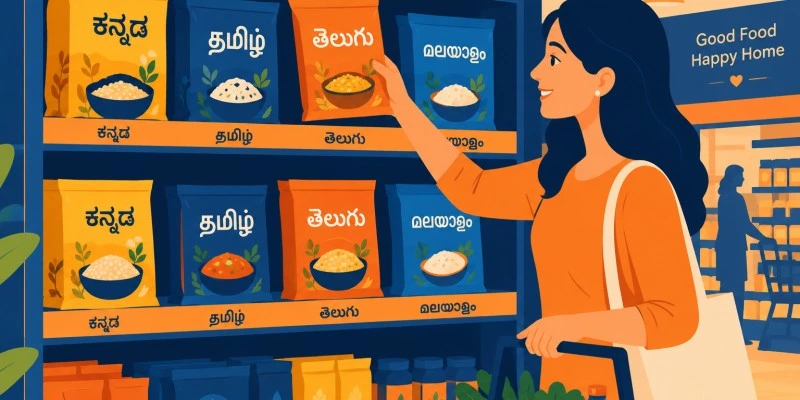
Regional language advertising that FMCG India brands invest in is no longer a side experiment. In South India, it’s often the deciding factor between a product shoppers reach for and one they walk past.
English campaigns still win big budgets. They’re easier to approve, easier to roll out nationally, and feel premium. But a shopper facing a shelf of twenty similar biscuits isn’t thinking about prestige. She’s thinking about trust, price, and whether the pack feels familiar.
This guide explains where regional language wins, where English still has a place, and how to build a practical South India FMCG marketing strategy that grows sales, not just impressions. It’s written for brand owners and startups in India and overseas who want to enter or grow in the southern states.
A message in the language you think in lands without a mental translation. Even people who read English comfortably tend to feel humour, warmth, and urgency more strongly in their mother tongue. FMCG marketing is a game of quick impressions, so that small edge matters.
Food, personal care, and household products enter the home and the body. Families lean towards brands that “sound like us”. Speaking Kannada, Tamil, Telugu, or Malayalam signals respect for local culture and a plan to stay.
In many households, the person who buys groceries, or shapes that decision, is a parent or grandparent more at ease in the local language. An English ad aimed at the family can miss the person holding the shopping list.
Much of the next wave of FMCG growth sits in tier-2 and tier-3 towns, where regional-language media carries more weight. New internet users in India also tend to come online in Indian languages, so local-language content is where fresh attention is.
Kirana owners, distributors, and sales reps speak to shoppers in the local language. Packs, posters, and shelf talkers that match that conversation help your product get recommended, not just noticed.
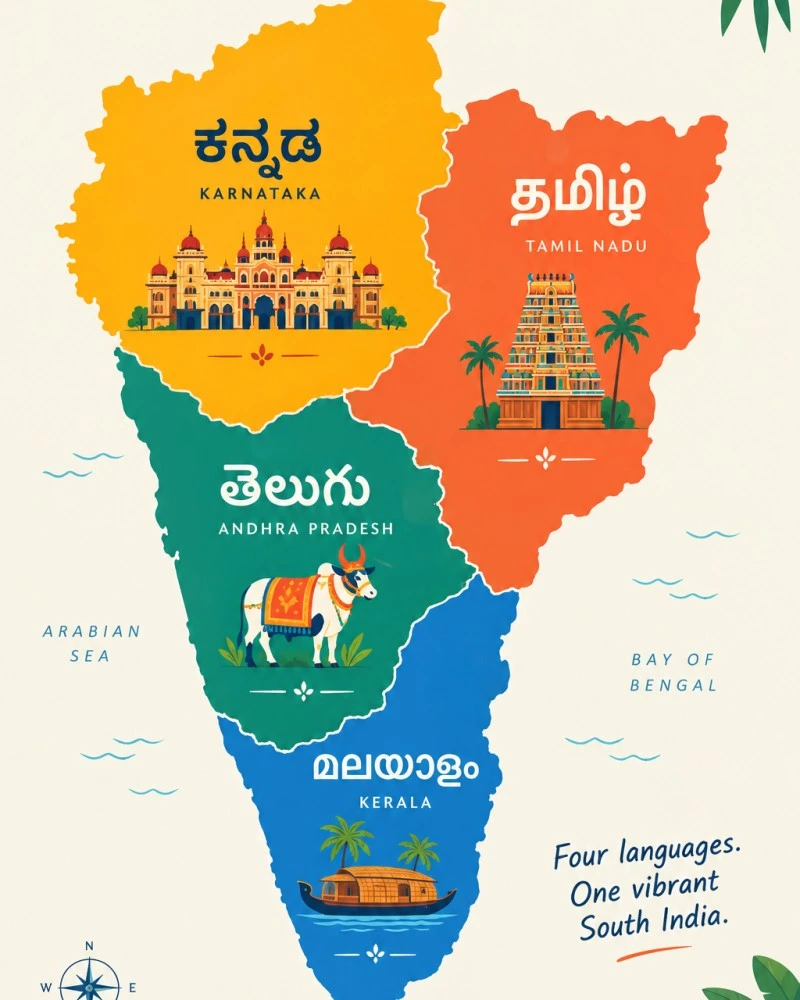
Treating the south as a single block is a common and costly shortcut. Kannada, Tamil, Telugu, and Malayalam carry different cultures, festivals, film worlds, and shopping habits. Even within a state, coastal, interior, and big-city audiences can differ. Bengaluru alone mixes Kannada, English, Hindi, and more.
Here are some broad tendencies. Treat them as starting hypotheses to test, not rules:
A workable South India FMCG marketing strategy treats each state as its own market, with its own creative, media mix, and trade plan.
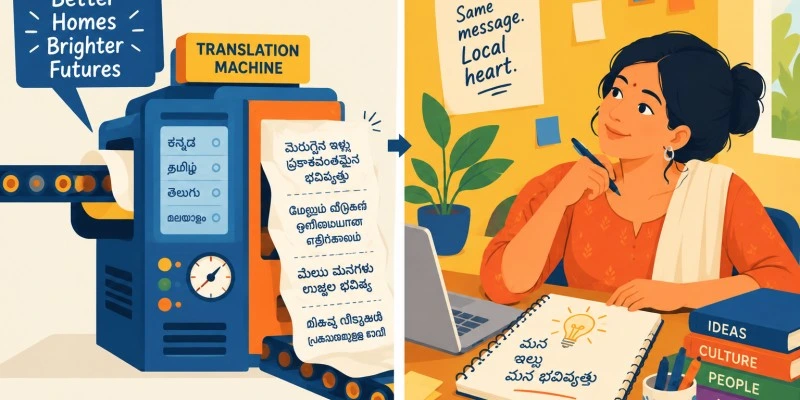
Here’s a mistake that sinks many campaigns. A brand writes a clever English line, hands it to a translator, and runs the result. It often sounds formal, flat, or even unintentionally funny.
Strong regional language advertising FMCG India shoppers respond to is usually transcreated. A native writer rebuilds the idea from scratch using local idioms, humour, festival moments, and everyday situations. Then it’s tested with real shoppers before launch. Check dialect, tone, and script too, because language as people text it differs from language on a hoarding.
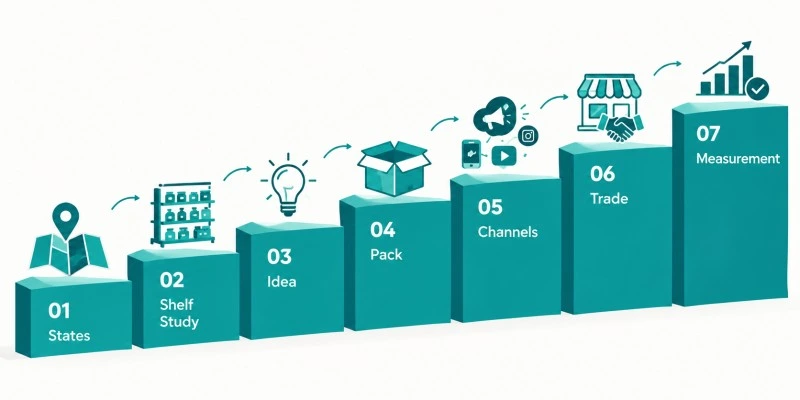
Don’t launch everywhere at once. Pick one or two states where you have distribution and prove the model there.
Visit kirana stores and supermarkets. Note competing packs, price points, label languages, and what shoppers pick up first.
Start with a local insight, such as a festival ritual, a family moment, or a food habit. Write the idea in the local language, not in English first.
Add the local language to labels, names, and promotional stickers. If the ad speaks Tamil and the pack doesn’t, the message breaks at the shelf.
Choose media where your shoppers actually spend time, whether regional TV, cinema, radio, outdoor, YouTube, or WhatsApp.
Brief your sales team and distributors in the local language. Give them posters, dealer boards, and simple talking points.
Track sales lift, repeat purchase, and shelf presence state by state, so you can see which markets deserve more money.
Good regional language advertising FMCG India brands rely on spans both traditional and digital channels:
These are illustrative patterns, not client results.
None of this means English is useless. The reason why regional ads outperform English India’s mass market is price sensitivity, habit, and trust, and those factors shift at the premium end.
English can work well for:
Often the best answer is bilingual: a regional headline with English product details, or two creative versions tested against each other.
To judge regional language advertising FMCG India campaigns, don’t rely on views alone. Track:
A simple test: run the regional and English versions in similar markets for four to six weeks and compare sales, not just clicks.
Most failed attempts at a South India FMCG marketing strategy share the same few mistakes:
Language wins attention, but it needs support behind it.
Boutique full-service agencies such as BUD India, which has called itself a “small big ad agency” since 2010, are built around this idea, with branding, creative, web, and digital under one roof.
Whether you hire a freelancer, build in-house, or pick an advertising agency Bangalore brands already work with, ask these questions:
Be wary of anyone promising overnight market share or one creative that “works everywhere”.
Regional ads are understood faster, trusted more, and remembered longer, especially for low-cost everyday products. The pattern is strong in South India, where each language carries deep cultural identity. It isn’t universal, so test by category and audience.
Start in one or two states where your distribution is strongest. Create region-first ideas with native writers, localise your pack, and test regional against English creative in similar markets before scaling.
Kannada, Tamil, Telugu, and Malayalam are the four major languages. Begin with the state where you already have shelf presence, then expand state by state.
Usually not. Literal translation often sounds stiff or awkward. Transcreation, where a native writer rebuilds the idea around local humour, idioms, and moments, performs better.
Sometimes. Premium and urban audiences often respond well to English or bilingual creative. Test a regional headline with English product details against a fully English version.
Early signals, such as recall and sales lift in test markets, can appear within four to eight weeks. Repeat purchase and market share gains usually take three to six months.
A Bangalore-based team can offer local insight and easier coordination, but location matters less than capability. Look for native writers in each language, proven regional work, and integrated services across brand, creative, web, and digital. Good FMCG marketing needs all of them working together.
Regional language advertising FMCG India shoppers respond to is rarely about translation. It’s about respect, familiarity, and showing up in the language people use at home. The reasoning behind why regional ads outperform English India-wide is simple: people buy what they understand and trust.
But language is a lever, not a whole plan. The brands that win in the south pair local ideas with consistent branding, packs that speak the same language, and trade support. Good FMCG marketing, in any language, starts with the shopper.
If you’d like a second opinion, start with a simple review of your packs, your creative, and one lead state. And if you’d like an advertising agency Bangalore businesses can partner with to connect branding, creative, your website, and digital campaigns into one plan, you can always start a conversation with a team that looks at the whole picture.
Bud India | Creative Advertising Agency, Bangalore
WE ARE AN OFFICIAL GOOGLE PREMIER PARTNER
