

You spent time finding that perfect post, saved it, reposted it to your feed with a quick caption, and waited. The views trickled in. An hour later, engagement was flat. The algorithm felt like it had buried the post before anyone saw it.
If that sounds familiar, you are experiencing something that millions of brands and creators have noticed in 2026: reposted and recycled content is being actively suppressed across every major platform. Not mildly punished. Actively throttled.
This is not an accident or a glitch. Every major social platform has spent the past two years building systems specifically designed to detect, flag, and deprioritise content that did not originate natively on their platform. The reasons are commercial and structural. And if you have been relying on reposts to fill your content calendar, the reach data you are seeing is the consequence.
This piece covers exactly why this is happening, which types of reposted content get penalised most severely, what the data shows about Instagram reach decline and the broader organic suppression trend, and what an original content strategy looks like in practice when you genuinely cannot create something new every single day.
According to data published by Addictive Digital in January 2026, organic reach on Facebook business pages has dropped to an average of 1.5% to 2% of total followers. Instagram's non-Reels feed posts average 3 to 5%. TikTok's organic reach remains higher for new accounts but falls dramatically for reposted content detected as duplicate. These numbers are not the floor. They are the current average, and they are still falling.
Understanding the mechanism makes the problem concrete rather than mysterious. Platforms do not simply notice that a piece of content has appeared before. They have built infrastructure specifically for this purpose.
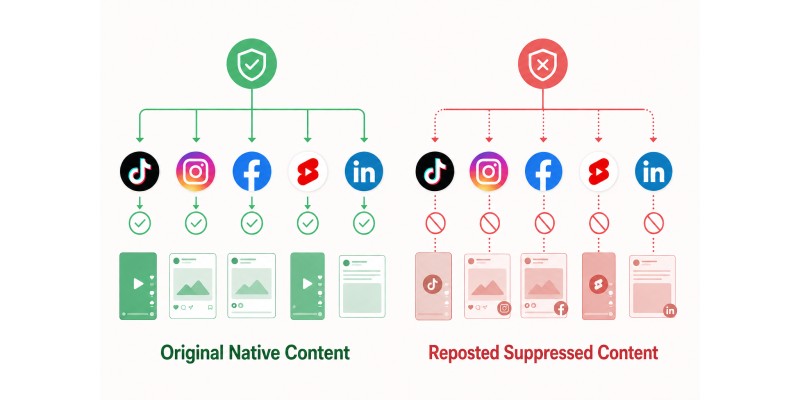
Every piece of content uploaded to a major platform is assigned a digital fingerprint: a hash generated from the visual, audio, or textual data in the file. When a video, image, or even a text post matches the fingerprint of something already in the platform's database, it is flagged automatically. The flag does not result in removal most of the time. It results in reduced distribution.
This is why a TikTok video downloaded and posted directly to Instagram Reels almost always has significantly lower reach than a video created natively in Reels. Meta's systems detect the match within the first few hours and limit how widely they serve the post to non-followers. By the time you notice the low reach, the algorithmic decision has already been made.
Meta made its position on TikTok watermarks explicit: content with visible competitor watermarks (TikTok's logo in the corner) is actively deprioritised on Reels and in the Facebook feed. This is not subtle. Instagram has stated this in creator documentation. The reasoning is straightforward: Meta does not want to serve as a distribution channel for a competitor's branded content.
The same logic applies in reverse. Content from Instagram with the Instagram watermark performs below average when cross-posted to TikTok or YouTube Shorts. Platforms read the watermark as a signal of non-native origin and reduce organic distribution accordingly.
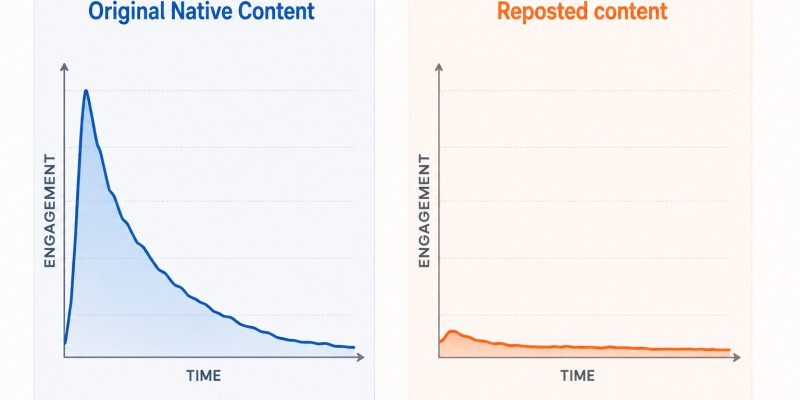
Original native content typically shows a specific engagement velocity pattern: rapid initial engagement from followers within the first thirty to sixty minutes, followed by a gradual spread to non-followers through algorithmic distribution. Reposted content shows a different pattern: flatter engagement velocity, often because the audience who would have engaged most has already seen the content elsewhere.
Algorithms use this velocity pattern as a quality signal. Content that does not
generate the expected engagement curve within the first hour receives less amplification. For reposted
content, the engagement curve rarely matches what original content achieves, partly because the novelty
signal is absent and partly because the platform's distribution has already been reduced before
meaningful engagement can accumulate.
The most significant shift in how Meta handles duplicate and non-native content came through a series of algorithm updates in late 2024 and early 2025, sometimes grouped under what observers called the 'originality update' framework. The most prominent Meta algorithm update specifically addressed what the platform called 'aggregator accounts': pages and profiles that gained reach primarily by resharing other creators' or brands' content rather than producing original material.
Meta's changes had three components that affected reposters directly.
Meta introduced an internal originality assessment that scores each piece of content based on how novel it is relative to existing content in their database. High-originality posts receive stronger algorithmic support. Low-originality posts, including reposts, see significantly reduced distribution to non-follower audiences. This score is not visible to creators or brands directly, but its effects show up clearly in reach data.
The originality score particularly affects Reels, which Meta identified as the primary battleground for short-form video in the Instagram reach decline context. A Reel created natively with original audio, original visuals, and a unique edit receives the full Reels distribution treatment. A Reel that duplicates existing content receives a fraction of that distribution regardless of how well-executed the repurposing is.
Previously, a post that performed well with a subset of followers would be distributed more broadly to non-followers as a reward. After the update, Meta began applying a stricter filter: content that reads as non-original or reposted is served primarily to existing followers only, with minimal non-follower distribution even if engagement from followers is strong.
This is significant for brand growth. Follower distribution alone does not grow your audience. Reaching non-followers is what builds audience. When reposted content is capped at follower-only distribution, it not only fails to grow your audience but also gradually teaches the algorithm that your account does not produce content worth recommending to new users.
Instagram's Explore page, Reels recommendation feed, and the broader Meta content recommendation system are how new audiences discover accounts. These systems are fed by content that has demonstrated novelty and strong engagement signals. Meta has confirmed that content flagged as low-originality is excluded from recommendation surfaces.
For brands, this means reposted content is essentially invisible to anyone who does not already follow you. It functions, at best, as a maintenance post for existing followers. It does nothing to expand your reach, and it actively reduces the platform's assessment of your account as a source of recommendable content.
Not all reposts are treated equally. Here is how different types of reposted content are handled across platforms in 2026:
| Content type | What happens to reach | Why platforms suppress it |
| Cross-platform repost | Immediate reach penalty on second platform | Duplicate hash detected in content DB |
| Screenshot reposts | Low reach after first 2-3 hours | Watermarks signal non-native origin |
| Reshared Stories | Under 20% of original story reach | No engagement signals added, flags spam patterns |
| Carousel repost | Reduced distribution to followers | Slide fingerprints matched to source post |
| IG Reel reposted to FB | Strong suppression on Facebook side | Meta's cross-app duplicate detection active |
| TikTok to Reels copy | Reels actively watermark-penalises | Explicit policy violation, algorithmic flag |
| Own old post reposted | Marginally better than cross-platform | Some allowance but engagement history absent |
The pattern across this table is clear: the more traceable the non-native origin, and the more explicitly the content was created for a competitor platform, the more severe the reach penalty. The exception is resharing your own old content, where the penalty is smaller but still present because the absence of new engagement signals prevents the algorithm from amplifying it.
Instagram has been the most aggressive platform in implementing content originality signals. The Instagram reach decline pattern that most brands have experienced since 2024 is not evenly distributed. Accounts posting original Reels and Stories with strong engagement have maintained or grown their reach. Accounts relying heavily on reposts and cross-platform content have seen reach collapse.
Instagram's recommendation system is built primarily around Reels. The platform has shifted its distribution model significantly toward Reels content for non-follower reach, while feed posts (static images, carousels) are served mostly to followers. For brands that relied on feed posts and reposts, this structural shift has had a compounding effect: less reach from each post type, and no growth from the Reels surface because reposted Reels are deprioritised.
According to reports shared by social media analysts in late 2025, brands that moved their primary investment from feed posts and reposts to original Reels content saw average reach increases of 40 to 60% within three months. The content quality did not change dramatically in these cases. The format and originality classification did.
Instagram Stories remain one of the best reach tools on the platform when used with original content: polls, questions, sliders, and genuine behind-the-scenes moments perform strongly. When Stories are used primarily to reshare posts (your own or others), the reach drops sharply after the first twenty-four-hour cycle because no new engagement signals are being generated.
The platform's data shows that interactive Stories (those with polls, questions, or reactions) are distributed more widely than Stories that simply reshare static posts. For brands treating Stories as a repost vehicle, this means they are missing the format's actual strength while also training their follower base to expect passive content with nothing to respond to.
Instagram has also introduced what some SEO and social media researchers are calling a 'freshness bonus': content that introduces genuine novelty to the platform receives amplified distribution for a limited window after posting. This freshness bonus applies specifically to social media content originality: new audio, new visual sequences, new formats, and topics not heavily covered by competing accounts in the same period.
For brands, this means the timing and originality of content combine as a reach signal. Original content on an emerging topic, or with a fresh creative approach, earns disproportionate distribution relative to what a similar post would achieve weeks later when the topic is saturated. Reposted content, by definition, cannot access the freshness bonus because its originality classification is low.
The response most brands have when told they need more original content is: we do not have the time or budget to produce original content every day. This is a fair concern. But the solution is not to repost instead of creating. It is to create less but make each piece more purposefully original.
Repurposing and reposting are not the same thing, and the distinction matters enormously for how platforms classify your content.
Reposting means taking content from another platform or another account and uploading it to your profile without significant transformation. The content fingerprint is largely the same. The platform recognises it as existing content and suppresses it.
Repurposing means taking the core idea, information, or story from existing content and recreating it natively in a new format for a new platform. You might take key points from a long-form blog post and create a carousel with original designed slides. You might take a key insight from an interview and record a short original video commentary. You might adapt a concept from a competitor's well-performing content and express your own perspective on the same topic in your own words and format.
Repurposed content, when executed with sufficient transformation, reads as original to platform algorithms because the content fingerprint is different. It also reads as more authentic to audiences because it has been created for them specifically rather than lifted from somewhere else.
One of the most practical shifts for brands with limited content production capacity is batching original content creation. Rather than producing one piece every day, a content batching session creates multiple pieces of original content in a single production block.
A three-hour batching session might produce: six original short-form videos recorded in a single location with multiple outfits or contexts, twelve original captions written for different use cases and audience segments, eight original Story frames designed specifically for mobile, and two original carousel concepts with fresh designed slides. That content, distributed across three weeks, provides consistent original posting without requiring daily production effort.
The key word is original. Every piece recorded and designed in that session needs to be created from scratch for the platform it will appear on, with native formatting, original audio, and content that does not duplicate existing posts.
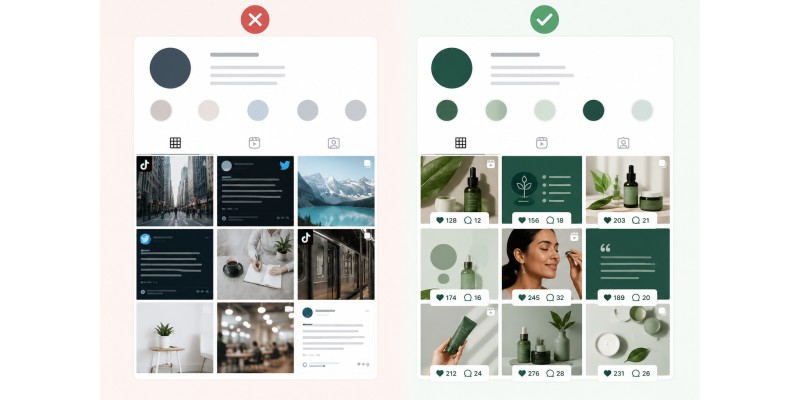
The most effective original content strategy for a brand is one built around perspectives only your brand can hold: your experience with your clients, your observations about your category, your specific expertise in what you do, and your cultural position in your industry or community.
A real estate developer in Bangalore can share what they have observed about buyer preferences in specific localities, with specific examples. A FMCG brand can share the behind-the-scenes reality of product development decisions. A B2B software company can share what they have learned from working with clients that no textbook or competitor report covers. These perspectives are genuinely original because they come from first-hand experience. No amount of reposting builds that kind of brand.
At Bud, working with brands across real estate, FMCG, education, and B2B in Bangalore, the accounts growing the fastest are not the ones posting most frequently. They are the ones posting most originally. A brand that publishes three genuinely original pieces per week, built around their specific expertise and client relationships, consistently outperforms one publishing daily with mixed original and reposted content. The algorithm notices. More importantly, the audience notices.
There is an important practical connection between organic reach suppression and paid social performance that most brands have not fully processed.
When an account's organic content is consistently classified as low-originality, it does not just suppress organic reach. It also affects the algorithmic profile the platform builds for your account. Meta's ad system uses account-level signals to assess content quality. An account flagged repeatedly for non-original content may experience higher CPMs, lower ad reach efficiency, or reduced eligibility for certain placement types compared to accounts with strong organic originality signals.
This is the specific context in which understanding the relationship between organic content quality and paid performance becomes commercially important. A Meta ads agency that builds paid campaigns on top of an organic presence weakened by repeated reposting is starting from a worse algorithmic baseline than one managing an account with strong organic originality signals. The paid campaigns can partially compensate, but they are working against a headwind that good organic strategy would eliminate.
The single most powerful move for Instagram reach in 2026 is producing original Reels with original audio, whether that is a voiceover recorded specifically for the post or a trending audio track applied to genuinely original video footage. Reels created entirely within the Instagram app, using in-app editing tools and audio, receive a native creation bonus that separately sourced content does not.
For brands who cannot create daily Reels: two original Reels per week outperform five reposted Reels in terms of both reach and account health signals. The quality of organic engagement from fewer original posts builds a better algorithmic profile than the weak engagement from more frequent reposts.
LinkedIn's algorithm in 2026 applies a specific reach bonus to posts written in the first person with documented personal experience. Sharing an article with a brief comment generates a fraction of the reach that an original post describing your specific experience or perspective on the same topic would achieve.
The most consistently high-reach posts on LinkedIn share a specific pattern: they start with a counterintuitive observation, describe a specific experience that led to it, and end with an actionable insight. This format works because it demonstrates original thinking rather than content aggregation.
Facebook organic reach is lowest for static content and reposted links. Original video, particularly video that poses a direct question or invites a specific type of comment, receives the strongest organic treatment. Facebook's algorithm still weights comment volume heavily as an engagement signal, which is why posts that invite specific responses ('what would you choose between X and Y') consistently outperform posts that simply share information.
Both platforms use watch-through rate as a primary quality signal. Content created specifically for the platform's native consumption pattern (vertical, fast-opening, structured for the format's typical viewer behaviour) dramatically outperforms content repurposed from another medium. A horizontal video cropped to vertical loses quality and viewer retention signals immediately. Original vertical video, recorded knowing the format, builds watch-through rates that earn algorithmic distribution.
Shifting from repost-heavy to original content requires tracking the right metrics to understand whether the change is working. The metrics that matter are different from the ones most brands monitor.
Raw reach numbers are misleading if your follower count is changing. Reach rate, which is reach divided by total followers expressed as a percentage, shows whether the algorithm is distributing your content widely or narrowly relative to your audience size. An improving reach rate after moving to original content indicates the algorithmic profile is improving, even if raw reach numbers are similar in the short term.
This is the metric that most directly shows whether your content is being recommended to new audiences. A high non-follower reach percentage (above 40% for most content types) signals that the platform is amplifying your content beyond your existing audience. A low non-follower reach percentage (under 20%) indicates that your content is being served primarily to existing followers and not being recommended further. As you build an original content strategy, this metric should increase over four to eight weeks.
Saves and shares are the highest-value engagement signals on most platforms in 2026. A post that gets twenty saves and fifteen shares from one hundred views is performing better algorithmically than a post that gets three hundred likes from the same one hundred views. Original content that offers genuine information value, entertainment, or a perspective people want to share with someone specific consistently generates better saves and shares than reposted content that audiences have likely already seen.
Yes, but less severely than reposting content from other platforms or accounts. When you repost your own content, the platform detects the matching fingerprint but applies a lighter penalty because the content originated on your account. The more significant problem is that reposted old content has no new engagement velocity, which means the algorithm does not amplify it the way it would a new original post. You are essentially paying the content creation cost without getting the reach benefit.
Sharing a feed post to your Story is different from reposting. It is a native Instagram feature and is not penalised in the same way. The limitation is that Story reshares of feed posts typically have lower reach than original Story content because they generate fewer responses, reactions, and reply signals. Using Stories to promote your own original feed content is still effective, but Stories themselves work best when the content within them is original.
Meta's cross-app duplicate detection means that content posted identically to both Instagram and Facebook will receive suppressed reach on at least one of the platforms. The safer approach is to post original to one platform and then significantly transform the content before posting to the other: different caption, different crop, different editing, or posting with a meaningful delay. Minor edits are not enough to avoid the duplicate detection.
Accounts that shift to consistent original content strategy typically begin seeing reach improvement within three to six weeks. The algorithm's assessment of your account does not reset immediately, but sustained original posting gradually rebuilds the originality signal and expands algorithmic distribution. Accounts that have been reposting-heavy for more than six months may take longer to recover because the account's engagement pattern has established a particular profile.
Paid advertising can reach audiences regardless of organic suppression, but it does not fix the underlying algorithmic profile issue. An account with weak organic originality signals and poor engagement rates will face higher CPMs and less efficient ad delivery than an account with strong organic performance. Building an original content strategy improves both the organic reach and the efficiency of paid campaigns. The two are not separate systems. They influence each other.
Reviewing your last thirty posts, counting how many were original content created specifically for the platform and how many were reposts, screenshots, or cross-posted content from elsewhere, is the most useful first step. For most brands, that audit reveals a ratio that explains the reach data they have been seeing.
The fix does not require infinite budget or a full-time content team. It requires replacing low-effort reposts with lower-frequency but higher-quality original content. Two original posts per week that your audience has not seen anywhere else, that reflect your specific perspective and expertise, will outperform ten reposted pieces that your audience may have already encountered on another platform.
The algorithm in 2026 rewards social media content originality specifically because platforms need fresh, engaging content to keep users active. When your account consistently provides that, the platform's incentive aligns with yours. When your account consistently provides content that already exists elsewhere, the platform has no reason to distribute it further.
Your brand's reach is directly connected to how often you give the platform something genuinely new to work with.
Bud India | Creative Advertising Agency, Bangalore
WE ARE AN OFFICIAL GOOGLE PREMIER PARTNER
