
A mid-size FMCG brand in South India books a full-page ad in a regional newspaper. The paper has a
claimed readership of 400,000. The ad runs on a Tuesday. Sales that week look the same as the week before.
Was the ad a failure? Was it working but unmeasurably? Did the right 400,000 people see it, or was it
380,000 wrong people and 20,000 who vaguely fit the target?
Nobody knows. That is the core problem with traditional advertising ROI, and it is the core reason why programmatic advertising has taken an increasing share of media budgets over the past decade. Global programmatic ad spend is forecast to exceed 800 billion USD by 2028. That number does not reflect a trend. It reflects a settled verdict among marketers who have had to justify their spend.
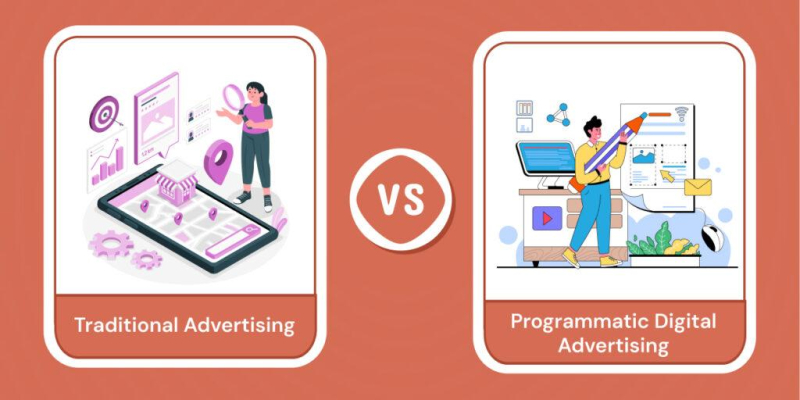
This article is a clear-eyed comparison of how programmatic advertising produces measurable ROI improvements over traditional media. It does not argue that traditional advertising is useless. It argues that the ROI comparison is not close across most modern advertising objectives, and explains why.
Traditional advertising covers television, radio, print (newspapers and magazines), outdoor (hoardings, transit ads, wall paintings), and direct mail. These channels share a common characteristic: inventory is bought in advance, at a fixed price, for a defined placement period. You pay for the slot before you know who will see it.
Programmatic advertising is the automated, data-driven purchase of digital ad inventory in real time. When a user loads a page, a millisecond auction runs. Advertisers bid for that specific impression based on who the user is, what they have been browsing, where they are, and dozens of other signals. The winning bid places the ad. The entire process completes before the page loads.
It is also worth clarifying where display advertising sits in this comparison. Understanding how display ads work is important here: display advertising refers to visual banner ads served through ad networks like Google Display Network. Display can be bought directly through a network or programmatically through a DSP. When people ask about display vs programmatic ads, they are usually comparing GDN-style direct buying against open-web programmatic buying through a Demand Side Platform. Both are digital, but they operate differently in terms of targeting depth, inventory access, and cost structure.
This article focuses on programmatic advertising against traditional media (TV, print, radio, OOH) because that is where the ROI gap is largest and most instructive.
Traditional advertising buys reach. A prime-time television slot on a national channel might deliver 10 million viewers. But the product being advertised is a B2B manufacturing software that only matters to operations managers at companies with more than 200 employees. Of those 10 million viewers, perhaps 40,000 are relevant. The remaining 9,960,000 impressions are waste.
This is not a hypothetical inefficiency. It is the structural reality of mass media. Traditional channels are built for reach, not precision. Their pricing reflects aggregate audience size, not audience relevance.
Why programmatic ads change this equation: every impression is evaluated before it is bought. The DSP assesses whether the user loading that page matches the defined target audience. If they do not match, the bid is not placed. Budget is not spent. Over a campaign, this filters out a large proportion of irrelevant exposures that traditional media would have charged for regardless.
A well-configured programmatic campaign can layer demographic targeting, behavioral signals (what content the user has been consuming, what they have been browsing, what they have purchased), contextual signals (the content surrounding the placement), geographic precision (down to a PIN code or a radius around a specific location), and first-party data (your own CRM of existing customers and leads). No traditional media channel can replicate this combination.
When a newspaper ad runs, it runs. If the creative is wrong, if the placement is underperforming, if a better opportunity exists in another section of the paper, none of that can be adjusted until the next booking. The money is spent and the result is fixed.
Programmatic campaigns generate performance data continuously. Click-through rates by audience segment, conversion rates by placement, engagement depth by creative variant, cost per acquisition by time of day. This data is available during the campaign, not after it. An experienced programmatic advertising agency reads this data and acts on it: shifting budget toward better-performing segments, rotating creative when engagement drops, adjusting frequency caps when a particular audience shows fatigue, tightening or expanding targeting based on early conversion signals.
The compounding effect of this matters. A campaign optimised three times over a four-week flight does not just perform marginally better. Each optimisation improves the baseline the next one works from. By week four, a well-managed programmatic campaign is typically spending its budget at meaningfully higher efficiency than it was in week one.
Traditional advertising ROI is often estimated rather than measured. A television campaign might be credited with a sales uplift based on a before-and-after sales comparison, controlling for seasonality and other factors. This methodology is not worthless, but it is imprecise. The attribution is correlation dressed up as causation.
Programmatic advertising tracks individual user journeys at the impression level. Which ad format generated the first exposure? Which segment produced the most view-through conversions? Which creative variant drove the highest post-click engagement? Which publisher placement had the lowest cost per acquisition? These are not estimates. They are data points from actual campaign activity.
This does not mean programmatic attribution is perfect. View-through attribution has known limitations, cross-device tracking is imperfect, and last-click models undercount assisted conversions. A competent agency acknowledges these limitations in reporting rather than overclaiming. But even imperfect digital attribution is substantially more actionable than the attribution available from a hoarding on a national highway or a 30-second radio spot.
Booking a prime-time television slot requires significant minimum spend, a production budget for the creative, and commitment to the placement weeks or months in advance. If the campaign underperforms in the first week, the budget is still committed. There is no pause button.
Programmatic campaigns can be paused, scaled up, scaled down, or redistributed across formats within hours. Budget can be shifted from underperforming audience segments to overperforming ones without renegotiating a contract. A campaign that is generating strong results in Coimbatore and weak results in Hyderabad can concentrate spend in Coimbatore the next day.
This flexibility is not just convenient. It is a direct ROI driver. Capital that would have continued flowing into a poor-performing placement under a traditional buy gets redirected to where it is working. The opportunity cost of inflexible traditional buying is real and largely invisible until you compare it against a digital alternative.
Traditional channels segment their audiences by broad categories: demographic profile of the channel's viewership, readership of a publication's core subscriber base, commuter patterns for outdoor placements. These are aggregated categories, not individual-level signals.
Programmatic can access data at the individual impression level: a user who has visited multiple property listing sites in the past 30 days, used a home loan calculator twice, and is located within 10km of a specific development. No television network can tell you that about their viewers. No newspaper can tell you that about their readers.
For categories where the purchase decision involves research before buying (real estate, healthcare, B2B services, high-value consumer goods), this depth of audience signal makes a material difference in campaign efficiency. You are reaching people mid-consideration, not hoping they happen to be watching television when your ad runs.
The table below compares how each approach performs across the factors that most directly affect advertising ROI.
| ROI Factor | Traditional Advertising (TV, Print, Radio, OOH) | Programmatic Advertising |
| Audience targeting | Broad demographic categories based on aggregated channel/publication audience data | Individual-level targeting using behavioral, contextual, intent, and first-party data layered simultaneously |
| Waste per impression | High: significant portion of impressions reach audiences outside the target profile | Lower: each impression evaluated against target criteria before the bid is placed |
| Campaign flexibility | Fixed after booking: creative, placement, and spend committed weeks or months in advance | Adjustable in real time: budget, targeting, creative, and frequency can be changed during the live campaign |
| Attribution quality | Estimated via sales uplift studies, panel-based measurement, or post-campaign surveys | Tracked at impression level: click, view-through, conversion, and engagement data available continuously |
| Minimum budget | High: prime-time TV or national print requires significant minimum commitment plus production costs | Scalable: campaigns can start at modest monthly budgets and scale based on performance data |
| Creative testing | Difficult: testing variants requires running different ads in different markets and comparing outcomes | Straightforward: multiple creative variants run simultaneously with performance data determining the winner |
| Mid-campaign adjustment | Not possible without rebooking or renegotiating placements | Continuous: underperforming segments, placements, and creative can be adjusted without additional commitment |
| Brand safety control | Context is known in advance but cannot be guaranteed at content level | Brand safety tools and exclusion lists control placement context; requires active management to be effective |
| Best ROI scenarios | Mass awareness, local community engagement, reaching audiences with low digital penetration, high-emotion product storytelling | Precise audience targeting, high-consideration purchases, B2B, regional/language-specific campaigns, multi-format nurture sequences |
Table: Programmatic vs traditional advertising across nine ROI-relevant factors
The ROI argument for programmatic over traditional is strong across most modern campaign objectives. It is not universal.
Television is still the most powerful medium for emotional brand storytelling at scale. A well-produced 30-second TVC on a national channel delivers something no banner or pre-roll video can replicate: a large, shared, high-attention context where the audience is in a receptive state. For consumer brands that need to shift cultural perception or build emotional associations at national scale, television does that better than any digital format.
Outdoor advertising in the right context still builds local brand presence effectively, particularly for businesses where physical location is part of the proposition. A hoarding outside a showroom, or at a junction near a development site, reaches people in a geographic context that is directly relevant to the offer.
Print still reaches audiences in specific categories who do not consume digital media at meaningful rates: older demographics in semi-urban and rural markets, specialist professional audiences who trust trade publications. In parts of India where digital penetration has limits, regional language newspapers remain an effective reach channel.
The practical answer for most brands is not one or the other. It is knowing which medium is doing which job, and measuring ROI accordingly. A TVC builds awareness at scale. Programmatic follows up by retargeting the people who searched for the brand after seeing it. Each medium does what it is actually good at.
The table and the theory make programmatic look like an obvious choice. In practice, programmatic ROI is not automatic. It is the product of specific decisions made before and during the campaign. Getting these right is what separates a programmatic engagement that delivers measurable return from one that produces impressive dashboards and unclear outcomes.
Programmatic's targeting precision is only as good as the brief behind it. A vaguely defined target audience produces vaguely targeted campaigns. The ROI improvement comes from specificity: knowing not just that your customer is a 35-year-old urban woman, but that she has been browsing home loan content for the past three weeks and lives within 8km of your project. That specificity requires work before the campaign launches.
Understanding how display ads work at the format level matters as much as the targeting. A native ad placed in an editorial environment is experienced differently from a banner in a sidebar. A pre-roll video is watched differently from a mid-article display unit. Creative that ignores these differences underperforms regardless of how precise the targeting is. Format-native creative is not optional for good programmatic ROI. It is the multiplier.
A programmatic campaign set up and left to run is not managed programmatic. The performance data that makes programmatic valuable only translates into ROI improvement if someone is reading it and acting on it. Frequency adjustments, segment shifts, bid strategy changes, creative rotation: these are the management activities that compound campaign performance over its lifetime. A Google Ads agency that cannot explain what their active management process looks like in specific terms is probably not doing it.
ROI can only be demonstrated if measurement is in place from day one. Conversion tracking, GA4 integration, CRM attribution, and (where the budget justifies it) brand lift studies should be configured before a single impression is served. Trying to retrofit measurement after a campaign runs produces incomplete data and arguments about whether the campaign worked.
Bud is a creative advertising agency based in Bangalore, operating since 2010 across real estate, FMCG, jewellery, B2B, education, and lifestyle categories. As a Google Premier Partner and programmatic advertising agency, Bud runs campaigns across Google Ads, Meta, LinkedIn, Taboola, and DSP-based programmatic for clients at various budget levels.
One thing that shapes how Bud approaches the display vs programmatic ads question with clients: the ROI argument for programmatic is only worth having if the creative is built to match. Bud's background is in creative advertising, which means the brief for a programmatic campaign includes the creative brief for each format it will run across. A campaign running display, native, and pre-roll video gets three separate creative briefs. This is not overhead. It is the reason the campaign performs.
Bud's experience with multilingual South Indian markets also matters for programmatic ROI. The FMCG campaigns run in Tamil, Telugu, Kannada, and Malayalam-speaking markets have consistently shown that language-specific creative outperforms translated creative by a significant margin in engagement and conversion metrics. For brands entering tier-2 cities in South India, this is a real budget decision: generic national creative versus locally written, format-native content. The ROI difference is not small.
Bud won two Gold and three Silver at the Big Bang Awards 2025 and has built 360-degree campaigns spanning TVC, outdoor, social, and programmatic digital for brands across South India. When programmatic is recommended, it is in the context of what the rest of the marketing mix is doing. When traditional media is the right call, that is the recommendation. The goal is ROI, not a preference for one channel over another.
Programmatic does not automatically produce better ROI. These are the failure modes that come up repeatedly:
For direct-response objectives (lead generation, product trial, app downloads), meaningful data is typically available within two to three weeks. The first two weeks are often spent establishing baselines and running initial optimisations. For brand awareness objectives, uplift measurement requires a longer window and a survey-based methodology. Expect 4 to 6 weeks for awareness campaign conclusions. Either way, programmatic produces actionable data faster than any traditional channel.
DSP-based programmatic typically becomes meaningfully efficient above Rs. 50,000 per month, accounting for platform fees and the need for enough data volume to optimise against. Below that threshold, a Google Ads agency running GDN campaigns is often more efficient for the same objectives. The minimum budget question is not about what is possible. It is about what generates enough data to make real-time optimisation meaningful.
For most Indian brands at mid-size budgets, the answer is alongside where traditional is doing a specific job that digital cannot. A TVC building brand familiarity at scale, combined with programmatic retargeting the people who searched for the brand after seeing it, is a more efficient combination than either in isolation. The question to ask is not which one to drop. It is what each channel is accountable for.
No. A Google Ads agency manages campaigns within Google's ad ecosystem: Search, GDN, YouTube, Performance Max. A programmatic advertising agency operates through DSPs that buy inventory across the open web from multiple exchanges simultaneously. The two practices require different platform expertise, different data infrastructure, and different creative approaches. Some agencies handle both. Many handle one well and the other as an afterthought. It is worth asking specifically.
Programmatic advertising delivers better ROI than traditional media in most modern campaign scenarios because it eliminates a large portion of wasted impressions, generates data that enables real-time campaign improvement, provides attribution that is measurable rather than estimated, and allows budget to be redirected toward what is working during the campaign rather than after it.
This advantage is not unconditional. It depends on a clearly defined audience, format-native creative, active campaign management, and measurement infrastructure set up before the campaign starts. Programmatic run poorly produces the same unmeasurable outcomes as traditional media, at digital speed.
Why programmatic ads have taken over a growing share of marketing budgets globally is not a mystery. It is the logical outcome of giving marketers real data, real control, and real accountability over where their money goes. The brands winning on ROI right now are the ones using that control deliberately, not the ones assuming the technology does the work on its own.
Programmatic does not guarantee ROI. It gives you the information and the levers to earn it. What you do with both determines the result.
Bud India | Creative Advertising Agency, Bangalore | budindia.com | +91 98868 33138
WE ARE AN OFFICIAL GOOGLE PREMIER PARTNER
