

Scroll through any brand's Instagram feed, open five competitor websites, or read their last ten blog posts. Then ask yourself: if the logo was removed, would you know which brand you were looking at?
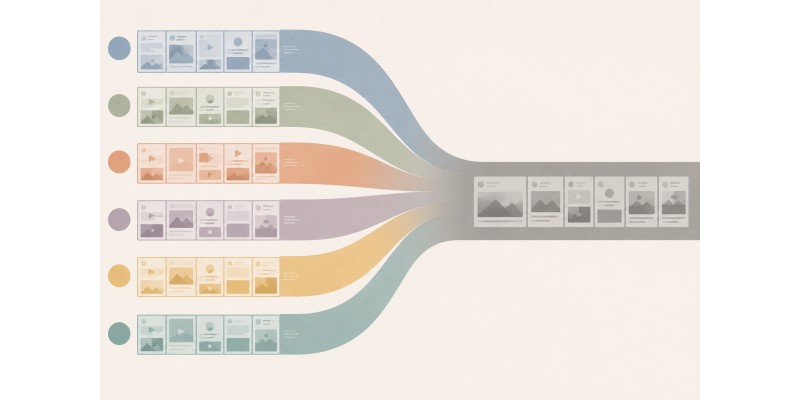
For a lot of companies right now, the honest answer is no. And the reason is not a shortage of marketing activity. It is that most of that activity is being produced by the same tools, trained on the same data, using the same prompt patterns, and delivered through the same channels in the same formats.
AI-generated marketing content does not have an originality problem because AI is bad. It has an originality problem because originality has to come from somewhere that AI does not have access to: your specific point of view, your genuine cultural position, your actual relationship with your customers, and the things you believe about your category that your competitors do not.
When you remove those inputs and replace them with a prompt, you get the statistical average of everything that has ever been written about your topic. That average is competent. It is grammatically correct. It is probably even optimised for search. But it looks exactly like everything else, because everything else was used to produce it.
This piece covers why this is happening technically, what it looks like in practice, and specifically what an AI branding strategy that avoids this trap actually requires.
Understanding why this happens at a technical level makes it easier to understand what to actually do about it.
Large language models learn from existing text. They identify statistical patterns: which words follow which other words, how ideas are structured, what phrases tend to appear in descriptions of specific categories or product types. When you ask an AI to write copy for a brand in a particular industry, it produces the most statistically likely output for that type of request.
That output is, by definition, the average of what already exists. It is not the most distinctive version of your brand's voice. It is the most common version of what brands in your category tend to say.
Every major AI writing tool, ChatGPT, Gemini, Claude, Jasper, Copy.ai, is trained on overlapping datasets that include significant portions of the same published internet content: blog posts, marketing copy, website text, product descriptions. When brands use these tools with similar prompts and minimal customisation, they are all pulling from effectively the same source material.
The output diversity between tools is narrower than most marketers assume. The stylistic patterns that define the current era of AI-generated content are not the patterns of any particular brand. They are the patterns of the internet's aggregate voice. And those patterns are now everywhere.
The second layer of the same-ness issue is prompt design. Most marketing teams using AI start with prompts that describe the output they want in terms of category, audience, and tone. Write a LinkedIn post for a sustainable clothing brand targeting millennials. Write a product description for a skincare serum for sensitive skin. Write an email subject line for a SaaS platform focused on HR teams.
The problem is that every competitor in the same category, writing for the same audience, is using structurally identical prompts. The inputs are near-identical, so the outputs converge. Two competing brands using the same tool with similar prompts will produce content that is more similar to each other than it is distinct, regardless of how different the brands actually are.
A 2025 Okoone study found that the proliferation of AI-generated content is creating a 'pervasive uniformity' that undermines brand creativity. Agency Squid's research from March 2026 is more direct: when AI gives every brand the same tools, strategy becomes the only durable advantage. The brands that understand this are building AI branding strategies around what AI cannot generate, not just around what it can produce efficiently.

It is useful to be specific about where this plays out, because the sameness problem is not abstract. It is visible in every category and on every channel.
AI image generation tools have produced a recognisable aesthetic. Soft gradients, pastel colour palettes, clean minimalist layouts, slightly too-perfect human faces, and floating geometric shapes. Midjourney, DALL-E, and Stable Diffusion have each created their own characteristic visual signatures, and brands using them without extensive customisation or human creative direction end up with imagery that signals 'AI' before it signals anything brand-specific.
This is not a problem with the tools themselves. It is a problem with how they are being used. A human art director with a strong AI-driven creative brief, specific reference images, a defined visual language, and iterative direction can produce distinctive, brand-specific imagery using these same tools. Most brands are skipping that process and using default settings with generic prompts.
There is a specific set of phrases and structures that have become the signature of AI-generated marketing copy. Sentences that begin with the brand name followed by a verb and a benefit. Headlines that combine three attributes in an alliterative or rhythmic structure. Calls to action that use 'discover', 'explore', or 'unlock'. Descriptions that reference 'seamless', 'effortless', or 'transformative' experiences.
These patterns are not wrong per se. They tested well at some point, which is how they got into the training data. But they are now so overused that they communicate nothing about a specific brand. When two competing brands in the same category both describe themselves as 'effortlessly transforming your experience', the phrase does not differentiate either of them. It just fills space.
This one is harder to see but more damaging. When content strategy is itself generated by AI tools that analyse competitive landscapes and recommend topics based on search volume and competitor content gaps, brands converge on the same editorial calendar. They write about the same topics, in the same sequence, at roughly the same time, because they are all using tools that are optimising for the same signals.
The result is not just that individual pieces of content look the same. It is that
entire content strategies across competing brands become structurally indistinguishable. Nobody in the
category is saying anything the others are not saying. Everyone is covering the same ground, reaching the
same audience, with the same messages.
Here is a direct mapping of how common AI-assisted marketing practices produce audience-detectable sameness:
| What brands do with AI | What it produces | What it signals to the audience |
| Generate copy from prompts | The same 5 sentence structures, repeatedly | This brand did not think about me |
| Use stock AI image styles | Gradient blobs, same soft-focus faces | This could be any company in this space |
| Automate social captions | High energy, low specificity, same format | This brand is performing, not communicating |
| Repurpose competitor content | Covered topics rather than owned opinions | This brand has no actual perspective |
| Scale ad creative with AI | Similar hooks, similar visual grammar | Scrolled past; this looks like every other ad |
| AI-written brand voice docs | Generalised tone words like 'warm' and 'bold' | Indistinguishable from fifty other brands |
Every row in this table describes a real pattern that real audiences have learned to recognise and discount. The problem is not any single instance of AI-generated content. It is the cumulative pattern that signals to your audience that your brand is not investing genuine thought in how it communicates.
The solution is not to stop using AI. It is to change what you are using it for, and to understand which parts of brand communication cannot be delegated to it.
Every brand that has ever been genuinely distinctive has had an opinion. Not a positioning statement, not a set of brand values written by committee, but an actual perspective on the category it operates in, the customer it serves, or the culture it exists within.
Oatly does not just sell oat milk. It has an opinion about the dairy industry that it expresses consistently across every touchpoint. Patagonia does not just sell outdoor clothing. It has a position on environmental responsibility that shapes every marketing decision. Zomato in India does not just facilitate food delivery. It has a voice and a perspective on the cultural relationship between Indians and food that makes every campaign recognisable as distinctly theirs.
That point of view cannot be generated. It has to be developed, debated, and committed to by people who have a genuine stake in the brand. AI can help express it. It cannot create it from nothing.
AI creative differentiation is only possible when the inputs are differentiated. The way to use AI for brand creative work is not to start with a category description and ask for output. It is to start with documented brand specificity: specific language patterns that are yours, visual references that represent your aesthetic, customer quotes that reflect your real relationship with your audience, and editorial positions that you have actually taken and can defend.
When those specific inputs go into an AI brief, the output is different from what any competitor can produce with a generic prompt. The tool is doing the production work, but the distinctiveness is coming from your inputs. That is the right division of labour between human brand thinking and AI production capability.
For paid advertising specifically, the sameness problem shows up in creative that looks and reads like every other ad in the category. The hook structures, the benefit statements, the visual formats: they converge because everyone is testing similar things and optimising toward similar engagement signals.
An AI ads strategy that produces differentiated output requires starting with creative hypotheses that are specifically yours rather than drawn from category norms. What is the one true thing about your product that nobody else is saying? What does your best customer say about you that they do not say about anyone else? What problem do you solve that your category usually pretends does not exist? Those starting points produce AI-assisted ad creative that is genuinely different because the strategic brief is different.
Brand identity marketing relies on consistency and recognisability across every touchpoint. The risk with AI in this context is not that any single piece of content is bad. It is that the consistency of AI-generated content is a different kind of consistency from brand consistency. AI is consistently average. Brand consistency means being consistently and distinctively yourself.
Building brand identity in the AI era requires creating assets that AI cannot replicate without your specific inputs: a visual language document that goes beyond colour palettes and fonts to describe specific imagery directions, compositional rules, and things the brand never does visually. A tone of voice document that includes actual examples of language the brand uses and language it rejects, with the reasoning behind both choices. A list of editorial positions: topics the brand has a specific view on, and what that view is.
These documents make AI tools dramatically more effective at producing
brand-consistent content. They also ensure that the brand consistency being produced is yours, not the
industry average.

There are a few specific mistakes that are worth naming directly, because they are extremely common and have a clear corrective.
AI's most obvious advantage is speed. Content that took a week now takes an hour. Campaigns that required significant production investment can be mocked up in minutes. The temptation is to optimise everything for speed, which means fewer inputs, less human creative direction, and more reliance on AI defaults.
Speed should not be the primary goal of AI-assisted marketing. Quality and distinctiveness should. The correct use of the time that AI saves is not to produce more of the same content faster. It is to invest more human creative effort in the things that make the content distinctive, which is the direction, the brief, the editorial position, and the review process.
Brands that have adopted AI at scale are sometimes producing five times the content they produced before. More blog posts, more social media variations, more ad creative, more email sequences. The assumption is that more presence creates more awareness.
What actually creates presence is memorability. A brand that produces one piece of content per week that consistently expresses a clear, specific point of view is more present in an audience's consciousness than a brand that produces five pieces of content per week that are competent but indistinguishable. Memorability requires distinctiveness. Distinctiveness requires human creative direction. Volume without that direction just creates more noise.
The final and most correctable mistake is publishing AI-generated content without a review process that applies brand judgment. AI output needs editorial direction, not just copyediting. The question is not whether the copy is grammatically correct. The question is whether it sounds like your brand, whether it says something your brand would actually say, and whether it is meaningfully different from what your competitors would say.
That review process cannot be done by AI. It requires someone who genuinely knows the brand, has a clear editorial standard, and is empowered to say 'this is technically fine but not what we would say'.
There is a concept from marketing science called brand distinctiveness, which refers to the sensory and linguistic cues that allow audiences to recognise a brand immediately: a specific colour, a sonic signature, a visual style, a verbal pattern. Research by the Ehrenberg-Bass Institute, which has studied brand growth across categories for decades, consistently shows that distinctiveness drives salience and salience drives market share growth.
AI-assisted marketing without human creative direction produces the opposite of distinctiveness. It produces category averages. And category averages, by definition, belong to nobody.
The brands that are going to maintain and grow their market positions over the next five years are not the ones that produce the most AI-assisted content. They are the ones that have a clear, defended, consistently expressed brand identity that AI helps them produce more efficiently, rather than replacing the identity altogether.
At Bud, working with brands across real estate, FMCG, education, and B2B in Bangalore, the pattern we see most clearly is that the brands growing fastest are the ones with the most specific brand voices, the clearest editorial positions, and the most differentiated visual languages. An AI digital marketing companythat helps brands develop those foundations before scaling AI-assisted production produces results that are consistently better than one that just increases content volume. The efficiency gain from AI is real. It only compounds into a competitive advantage when the inputs are distinctive.
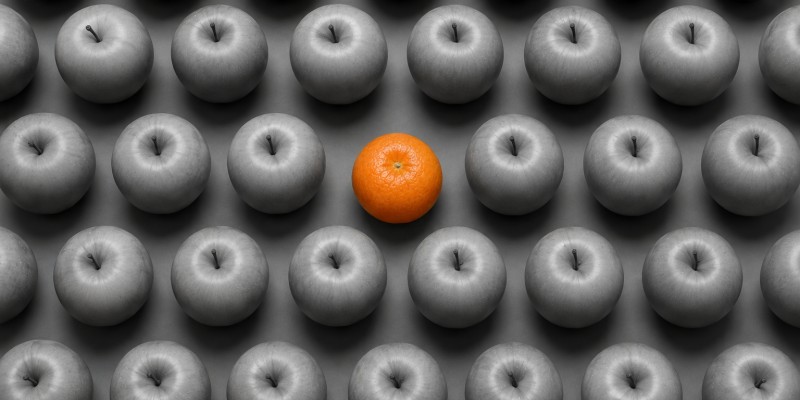
Rather than abstract principles, here is a concrete sequence for building an AI branding strategy that produces distinctive rather than average output.
Start with proprietary content: things that are true about your brand that a competitor could not say with equal credibility. Your founding story, your specific product innovation, your customer relationship history, the problems you have solved that your category usually avoids discussing. These are the inputs that make AI-generated content distinctive rather than generic.
Standard brand guidelines describe visual identity and tone of voice at a high level. A brand input document goes further: it includes specific words the brand uses and words it never uses, specific visual directions for AI image tools, example outputs that represent the brand at its best, and example outputs that represent the kind of generic content to avoid. This document becomes the mandatory input for every AI-assisted production task.
The strategic layer of brand communication, what to say, who to say it to, when to say it, and why it matters, should remain human-led. AI is most valuable in the production layer: taking a well-developed strategic brief and producing multiple executions of it efficiently. This division keeps the distinctiveness inputs human and the efficiency gains from AI, rather than letting AI determine both.
Add a distinctiveness review to your AI content approval process. The question is not just whether the content is good. The question is whether it is specifically yours. Could a competitor publish this with their name on it and have it fit equally well? If yes, it is not distinctive enough to go out.
AI saves time and money on production. That saving should be reinvested in the things AI cannot do: deeper customer research, stronger creative briefs, more iterative brand voice development, and more rigorous editorial review. The goal is not to reduce the total creative investment. It is to shift where that investment goes.
AI-generated content is only as distinctive as the inputs given to it. Generic prompts produce generic outputs. Highly specific prompts that include your brand's actual language patterns, documented editorial positions, specific visual references, and proprietary content can produce outputs that are genuinely distinctive. The tool's capability is not the limiting factor. The quality and specificity of the brief is.
Categories where brands have historically competed on communication quality rather than product differentiation are most vulnerable: financial services, professional services, software and SaaS, consumer packaged goods, and fashion. These are the categories where brand voice has historically created competitive advantage, and where AI-driven convergence is therefore most damaging. Product-led categories with strong patent protection or unique formulations are less immediately affected because the product itself creates differentiation that content strategy does not have to carry.
AI branding strategy requires the same foundational elements as traditional brand strategy: clear positioning, documented brand voice, defined visual identity, and consistent editorial direction. The difference is in how those elements are applied. In an AI-assisted workflow, the brand strategy documents need to be specific enough to serve as inputs to AI tools, not just broad principles that guide human creative decisions. Brand strategy in the AI era needs to be more granular, more specific, and more operationalised than it was when every content piece was individually created by a human.
The primary risk is audience indistinguishability. If your brand is not recognisably yours across its marketing communications, the cumulative investment in marketing activity does not build brand equity. You get impressions and clicks, but you do not build the mental availability and brand distinctiveness that translate into long-term market share. The secondary risk is that the sameness problem compounds over time: as more brands increase their AI content volume, the competition for audience attention in a sea of similar content intensifies, and brands without a clear distinctive voice will lose visibility relative to those that have one.
Directly. Advertising performance in paid channels depends heavily on creative quality, and creative quality in a competitive environment means creative distinctiveness. An AI ads strategy built on distinctive brand inputs consistently outperforms one built on category norms because it earns more attention from audiences who have learned to scroll past familiar ad patterns. Google's own research shows that creative quality drives a larger share of ad performance than targeting precision. Distinctive creative that reflects genuine brand identity is both the most sustainable AI ads strategy and the one with the highest ceiling for performance improvement.
Most brands have not yet seriously addressed the sameness problem. They are aware of it in the way you are aware of a persistent background noise: present, mildly concerning, but not yet treated as a strategic priority.
This creates a window. The brands that invest now in building the specific brand inputs, editorial positions, and distinctive creative languages that make AI tools produce genuinely differentiated content will build a compounding advantage over the next two years. The brands that continue producing high-volume generic content will discover that the efficiency gains from AI are eroded by the cost of audience attention lost to sameness.
The investment required is not primarily financial. It is intellectual. It requires people who know the brand deeply to make difficult decisions about what it stands for, what it would never say, and what makes it specifically itself rather than a category average. That kind of creative and strategic clarity has always been the foundation of distinctive brand communication. AI has not changed the requirement. It has made the consequences of not having it more immediate.
Bud India | Creative Advertising Agency, Bangalore
WE ARE AN OFFICIAL GOOGLE PREMIER PARTNER
