
Every few months, a business owner looks at the ad invoice and wonders whether an agency they hired, or the in-house team they pay, is really worth the money. The next thought is almost always the same: “What if we just switched everything off for a month?”
It’s a fair question. Ad spend is a big line item, and nobody likes paying without proof. But a 30-day pause is a bold experiment, and the results rarely match expectations. Some businesses barely notice. Others watch enquiries dry up by week three.
This guide by Bud Google Ads Agency walks through what usually happens, why the damage often shows up late, and how to test the value of your ads without gambling your pipeline. It’s written for business owners and startups in India and overseas.
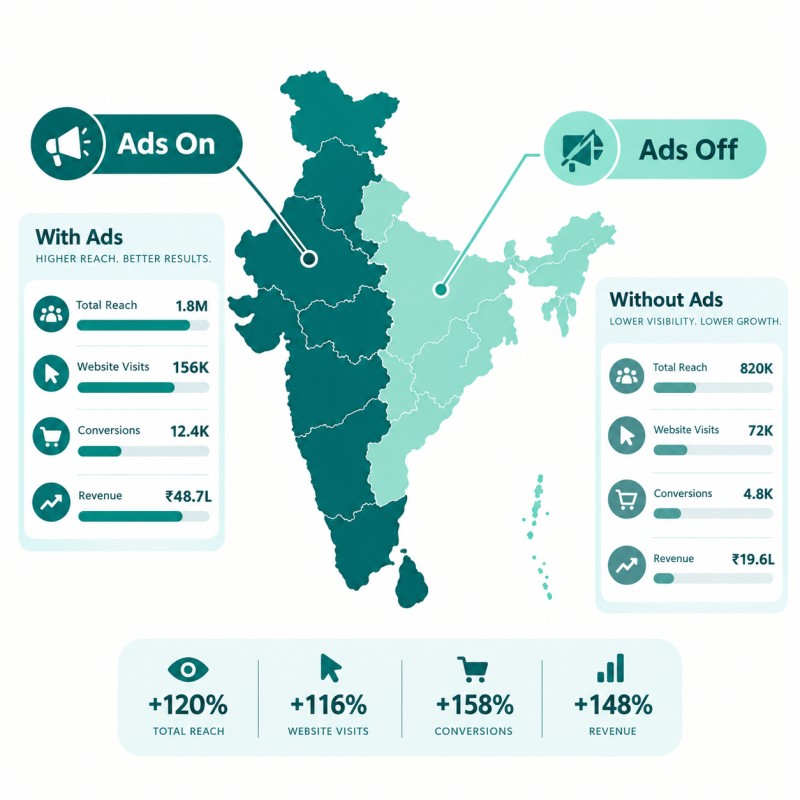
When you pause campaigns, ads stop showing within moments and spend drops to zero. Paid clicks, calls, and form fills fall right away. Organic and direct visits carry on, and some people who would have clicked an ad will find you another way.
But organic rarely replaces paid fully. Ads reach people who weren’t searching for you by name, and they put you in front of buyers at the exact moment they’re ready to act. Switch them off, and that stream stops.
How hard the stop hits depends on three things:
Every account behaves differently, so treat this as a typical pattern, not a guarantee.
Spending is zero, so finance is happy. Reports show a clear drop in paid visits, but organic and direct traffic hold steady, so total traffic looks only slightly lower. Leads from before the pause are still being followed up, so revenue looks normal.
This is the most misleading week. Nothing has broken yet, but the pipeline has stopped refilling.
Sales teams are still closing earlier enquiries. Online stores lean on repeat customers and email sales. The first sign of trouble is usually new-customer volume. If you run an e-commerce store, watch first-time buyers. That number tends to slip before total revenue does.
Fresh enquiries thin out. Your sales team has fewer new people to call, and the conversations that used to start from an ad simply don’t happen. Remarketing audiences start shrinking as older visitors expire from your lists.
Meanwhile, rivals who kept spending are collecting the clicks you left behind. On searches for your own brand name, a competitor’s ad may now appear above your organic result.
By now you can see what the ads were truly contributing. You also face a decision: restart or stay off.
Restarting isn’t flipping a switch back on. Smart bidding relies on recent conversion data, and a long gap can mean a relearning phase with uneven results. Many advertisers return at a careful budget and discover how much ground competitors gained.
If a pause really hurts, why do so many teams think it went fine? A few reasons.
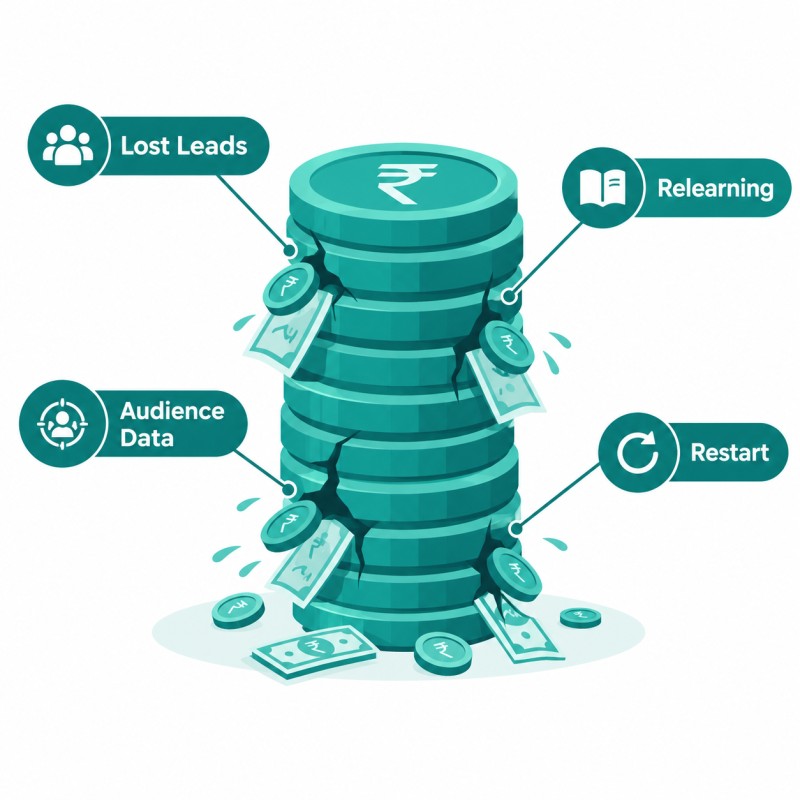
Pausing saves the ad budget. It doesn’t save you from the other costs: lost leads, relearning time, lost audience data, and the effort of rebuilding campaigns and creatives.
Here is a simple, illustrative example for a B2B company:
Pausing saves ₹80,000 but puts ₹5,00,000 in pipeline at risk. Now flip the picture. If the same spend produced no qualified leads for three months, even after fixing the landing page and targeting, pausing would be the smarter move.
The lesson is simple. The right answer comes from your own numbers, not from a rule of thumb.
Impact differs sharply by business type. These are illustrative patterns, not client results.
| Business type | Likely effect of a 30-day pause | Why |
| Local services and real estate | Noticeable within 2–3 weeks | High-intent local searches go to rivals |
| Jewellery and fashion | Strong impact in sale and festive windows | Demand peaks are short and expensive to miss |
| E-commerce and D2C | First-time buyer volume drops quickly | Less repeat revenue to cushion the gap |
| B2B and long-cycle sales | Delayed, often visible in month 2–3 | The pipeline masks early losses |
| Well-known FMCG and lifestyle brands | Milder, thanks to branded demand | Shoppers search for the name directly |
| Education | Painful if paused before admissions season | Demand is concentrated in short windows |
If your real goal is to find out whether ads are pulling their weight, there are safer experiments.
These methods answer the real question, “what are my ads adding that I wouldn’t get anyway?”, without wiping out your momentum.
Looking only at the ad dashboard won’t tell you the full story. Watch these instead:
Set a stop rule in advance. For example: if qualified leads fall by 25 percent, restart immediately. A rule you agree on beforehand keeps emotion out of the decision.
Sometimes switching off is genuinely wise:
In these cases, pause, fix the root problem, and restart with a clear plan.
How much a pause hurts often reflects how strong the rest of your marketing is. Brands people already know and trust lose less when ads stop. New or unfamiliar brands lose more.
That’s why ads shouldn’t carry the whole load:
When you review your ad strategy, look for a partner who thinks beyond the click. A good performance marketing agency will start with your margins, your funnel, and your brand strength before suggesting any budget change. Boutique full-service teams such as BUD India, which has called itself a “small big ad agency” since 2010, are built around this integrated approach.
Your ads stop showing immediately, and paid clicks and leads fall within hours. Organic and direct traffic continue, but most advertisers see fewer new enquiries by weeks three and four. On restart, campaigns may need time to relearn and win back lost positions.
Will my organic traffic increase if I turn off ads?Usually only slightly. Some people who would have clicked an ad may click your organic listing instead, but total leads typically fall because ads reach buyers organic results miss.
Does pausing ads hurt my account history?Pausing doesn’t normally erase your account history. The bigger risks are weaker recent conversion data, a relearning phase after restart, and competitors gaining ground while you’re away.
Is it better to reduce the budget than pause completely?In most cases, yes. A lower budget keeps data flowing and keeps you visible, while a full pause removes both. Cutting only the weakest campaigns is usually the smartest first step.
Can I pause for just a few days?Yes. Short pauses are far less disruptive than month-long ones. Monitor performance closely when you restart and avoid heavy changes immediately afterwards.
How do I know if my ads are really working?Compare total leads and revenue across all sources, run a geographic or campaign-level holdout test, and check branded search trends. Don’t rely only on platform-reported conversions, because they may count sales that would have happened anyway.
Do I need an agency to manage Google Ads?Not always. A skilled in-house marketer can manage a small account. Outside help makes sense when you need strategy, creative, landing pages, and tracking working together, or when internal bandwidth is limited.
How long does it take to recover after restarting?It varies by account, budget, and how long ads were off. Many accounts take a few weeks to stabilise, and some need longer if competitors have moved in. Restarting in phases helps.
Turning off your ads for 30 days won’t end your business, but it will teach you something, and the lesson can be expensive. The damage often hides for weeks, then shows up in your pipeline before it shows up in your reports.
Before you pull the plug, look at your margins, your sales cycle, and your brand strength. Then test in small steps with clear targets and a restart plan. Often the best answer isn’t “off”. It’s “less, and smarter.”
If you’d like a second opinion, start with a simple audit of your campaigns, landing pages, and brand presence. And if you want a team that can connect branding, creative, your website, and paid media into one plan, you can always start a conversation with an agency that looks at the whole picture.
Bud India | Creative Advertising Agency, Bangalore
WE ARE AN OFFICIAL GOOGLE PREMIER PARTNER
