
A small business marketing budget Bangalore owners can actually defend starts with a nervous question: are we spending too little, too much, or in the wrong places?
Most owners guess. Some copy a competitor. Others spend whatever is left at the end of the month, which is usually very little. None of that is a plan.
This guide gives you a practical way to set the number: realistic ranges, a calculation you can run yourself, a sample split across channels, and the mistakes that quietly burn cash. It’s written for business owners and startups in India and overseas, with Bangalore’s crowded market in mind.
These ranges are general benchmarks, not Bangalore-specific survey data. Adjust them for your own margins.
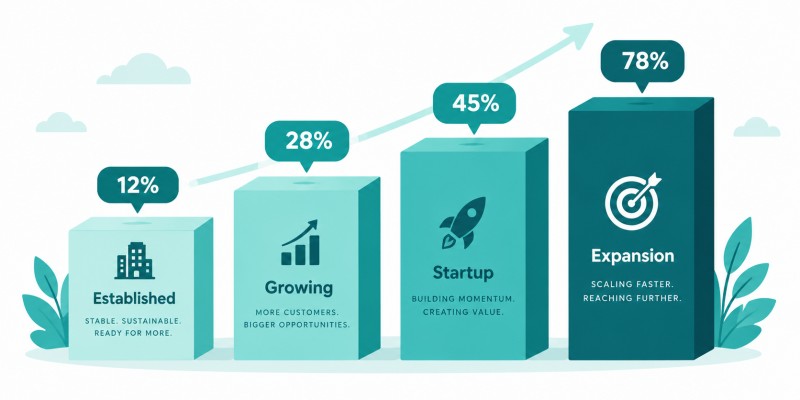
| Business stage | Typical share of revenue | What it usually funds |
| Established, steady demand | 3–6% | Staying visible and protecting market share |
| Growing small business | 7–12% | Steady lead flow plus some brand building |
| New launch or early-stage startup | 12–20% or more | Building awareness and learning what works |
| Aggressive expansion | Above 20% | Only with healthy cash and proven unit economics |
Several things push you higher: low brand awareness, tough competition, a new launch,
and strong repeat purchases. Others pull you lower: steady referrals, loyal customers, and limited capacity
to serve more people.
One caution about any marketing budget percentage of revenue India 2026 benchmark: it looks backwards. If sales dip, the budget shrinks right when you need more visibility. Many smart owners set a floor, a minimum that continues through slow months.
When deciding how much to spend on marketing small business India owners should weigh five factors.
Margins. A jeweller with healthy margins and large ticket sizes can spend differently from a food brand on thin margins. Work from contribution margin, not just revenue. If you keep only ₹20 of every ₹100 sold, a 15% marketing spend eats most of your profit.
Sales cycle. Real estate, education, and B2B deals take weeks or months, so today’s spend pays back later. Food and fashion show returns faster.
Local competition. Some Bangalore searches, such as property, schools, and coaching, are expensive because many advertisers chase them. Check cost per click before fixing a number.
Brand awareness. Known brands pay less to win each customer, since people search for them by name. New brands must buy attention first.
Lifetime value. If customers buy again and again, you can pay more to win the first order. If they buy once, you can’t.
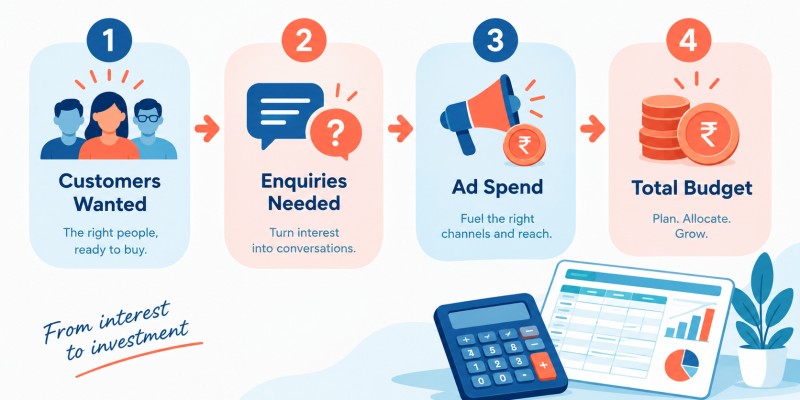
You don’t need a special tool. Work backwards from the customers you want. Here is an illustrative example for a home décor store:
Total: about ₹1,04,000 a month.
Now run a sanity check. Twenty customers at ₹15,000 is ₹3,00,000 in first-order revenue. At a 40% margin, that’s ₹1,20,000 in gross profit, so you roughly break even on the first sale. Repeat purchases create the real profit. If customers rarely return, lower the budget or improve conversion first.
That 35% looks high next to typical marketing budget percentage of revenue India 2026 ranges, but it’s measured against first orders from new customers only, not total revenue. Repeat sales bring the overall share down.
This is the logic behind any digital marketing budget calculator Bangalore agencies or online tools offer. The inputs matter more than the tool: your close rate, average order value, and cost per enquiry. Swap my assumptions for yours.
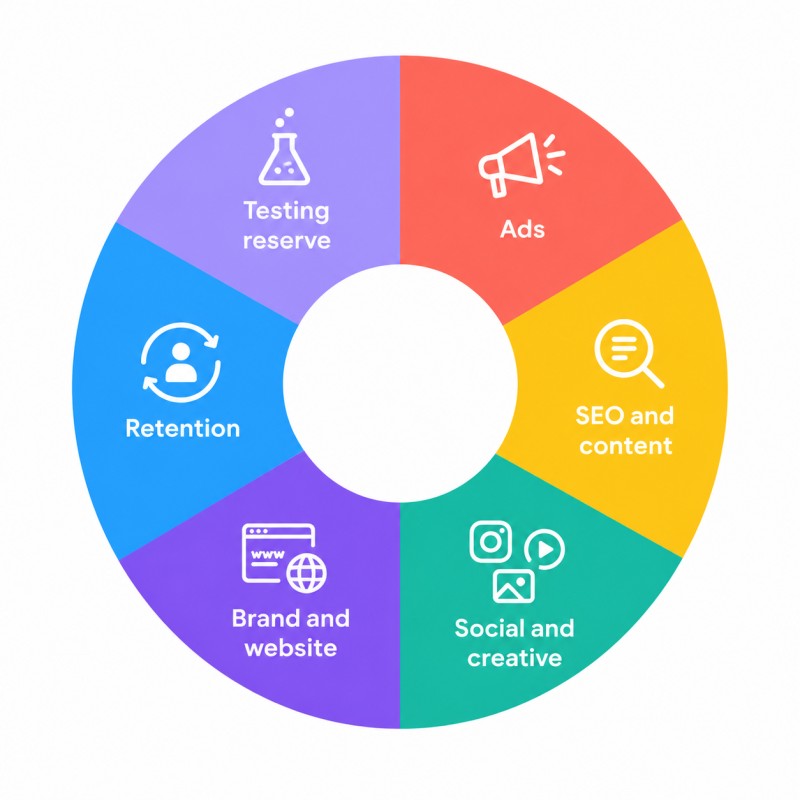
Here is an illustrative split for ₹1,00,000 a month:
| Area | Share | Amount |
| Paid search and social ads | 35% | ₹35,000 |
| SEO and content | 20% | ₹20,000 |
| Social media and creative | 20% | ₹20,000 |
| Brand and website upkeep | 10% | ₹10,000 |
| Email, WhatsApp and retention | 5% | ₹5,000 |
| Testing reserve | 10% | ₹10,000 |
Early-stage brands usually lean towards paid media for fast feedback. Established
ones shift towards SEO and retention. B2B firms put more into LinkedIn and lead handling.
The most common slip in a small business marketing budget Bangalore founders set is spreading too thin. ₹10,000 across eight channels does little anywhere. Fund two or three channels properly, and add more only when the first ones work.
These patterns show how a small business marketing budget Bangalore owners might plan differs by sector. They are not client results.
Ad money only works as hard as what sits behind it.
Boutique full-service teams such as BUD India, which has called itself a “small big ad agency” since 2010, are built around this idea, with branding, creative, web, and digital under one roof.
Not every business needs an agency. A capable in-house marketer can run one or two channels well. Outside help pays off when you need strategy, creative, web, and ads working together, or when your team is stretched thin.
Fees vary widely, from modest monthly retainers for a single channel to much larger sums for multi-channel work. Ad spend goes to the platforms and is separate from agency fees, so always ask for both numbers.
When you shortlist a digital marketing agency in Bangalore, compare what each quote includes. One fee may bundle SEO services, performance marketing services, and social media marketing services, but the depth behind each label can differ a lot. Ask for hours, deliverables, reporting, and who actually does the work.
Good questions to ask:
Days 1–30: Know your numbers
Days 31–60: Fund and fix
Days 61–90: Review and reallocate
So what small business marketing budget Bangalore owners should settle on? There’s no universal number, but there is a sound method. Start from a percentage range, test it against your own goal, and protect a floor in slow months.
Whether you’re working out how much to spend on marketing small business India wide or planning your first campaign, remember that the marketing budget percentage of revenue India 2026 ranges are a guide, not a rule. Your margins, sales cycle, and brand strength decide the final figure.
If you’d like a second opinion, start with a simple review of your margins, your funnel, and your current spend. And if you’d like an agency in Bangalore to connect branding, creative, your website, and performance marketing into one plan, you can always start a conversation with a team that looks at the whole picture.
Most startups begin between 10% and 20% of expected revenue, because they must build awareness from scratch. Established small businesses often spend 5% to 10%. Whatever you choose, tie it to a clear goal, such as a number of customers per month, and review it every quarter.
Expect to spend toward the higher end of your range in year one, since you’re building the website, brand, tracking, and first audiences at the same time. Keep 10% as a testing reserve, and review results after 90 days.
There’s no single figure. Many small businesses land between 5% and 10%, growing ones go to 7% to 12%, and new launches can go higher. Choose based on margins, competition, and how quickly you need results.
Plenty of online calculators exist, but a simple one you build yourself is often better. Work backwards from your goal: customers needed, close rate, and cost per enquiry. Then add about 35% for creative and tracking and a 10% testing reserve.
An in-house marketer suits one or two channels. An agency makes sense when you need strategy, creative, web, and paid media working together, or when your team lacks time. Many businesses mix both.
Ads bring leads in weeks, while SEO usually takes three to six months but keeps paying afterwards. Early on, lean towards ads for quick feedback. Once campaigns are proven, move 15% to 25% of the budget into SEO and content.
Paid campaigns can show signs within weeks. SEO usually needs three to six months. Brand building pays off over longer periods. Judge each channel on its own timeline.
Usually not fully. Keep a floor so you stay visible, and trim only the campaigns that lose money. Rivals who keep spending will take your share.
Bud India | Creative Advertising Agency, Bangalore
WE ARE AN OFFICIAL GOOGLE PREMIER PARTNER
