
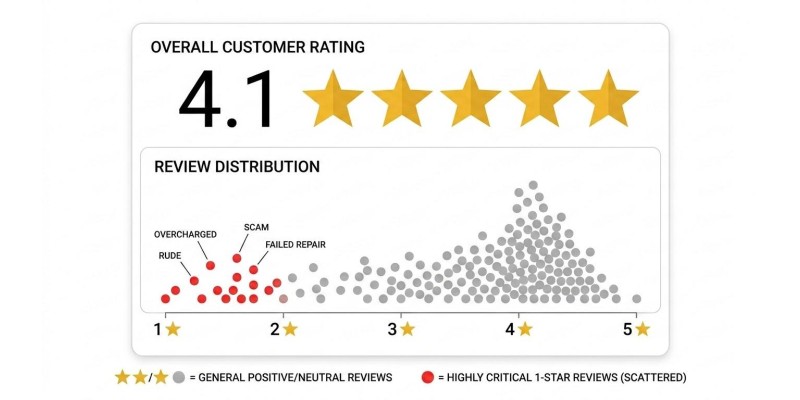
A patient searches for a dermatologist in Indiranagar, Bangalore. Before the blue links appear, Google's AI Overview generates a summary at the top of the page. It reads: 'Dr. [Name]'s clinic in Indiranagar has received mixed feedback online. Several patients have noted long wait times and difficulty reaching the front desk. Some reviews mention unexpected billing charges.' The clinic has 4.1 stars overall from 94 reviews. Most are positive. But the AI did not summarise the positive reviews. It extracted and synthesised the complaints.
The doctor did not do anything wrong. Nobody hacked the account. No competitor paid for negative placement. Google's AI simply read the reviews, identified the recurring negative themes, and surfaced them as the most 'informative' content to help the searcher make a decision. The AI Overview now functions as a permanent, algorithmically-curated negative summary appearing above everything else the clinic has built online.
This is the new reputation threat that most Indian local businesses and service companies have not yet encountered but will. Google AI Overviews reputation management is no longer optional for any brand with a review presence online. This article explains exactly how the problem works, which business types are most at risk, and what practical steps address it before an AI Overview does lasting commercial damage.
Google AI Overview does not show your average rating. It shows a synthesised narrative. And the algorithm that builds that narrative has a preference for specific, emotionally charged, complaint-driven content over generic positive feedback.

Google AI Overviews are generated by a large language model that synthesises
information from multiple sources to answer a search query directly. For local business and service queries
(a doctor, a restaurant, a contractor, a school, a real estate developer), the AI draws primarily from
Google reviews, third-party review platforms, news coverage, and community discussions to answer the implied
question: 'Is this business worth choosing?'
The AI does not compute a weighted average of sentiment and report it. It identifies recurring themes, specific named complaints, and contextually salient information that helps the searcher understand what to expect. Specific, concrete complaints (a named issue, a specific incident, a recurring service failure) carry more informational weight than generic praise ('great service', 'highly recommend') because they contain more actionable information for someone deciding whether to visit.
The Ariel Digital Marketing analysis of how AI Overviews surface local reviews confirms this pattern: AI Overviews disproportionately surface negative reviews in their summaries for local businesses because negative reviews tend to be more specific, more detailed, and more contextually informative than positive ones. A one-star review that says 'waited 90 minutes past my appointment time, staff was dismissive when I complained, and was charged for services I did not receive' gives the AI more to work with than a five-star review that says 'wonderful experience, will definitely return.'
This is not a bug. It is the algorithm functioning as designed: finding the most specific, information-rich content to help searchers make informed decisions. The unintended consequence for businesses with even a modest number of detailed negative reviews is that those reviews become the headline of the AI search reputation summary, regardless of the overall rating or review volume.
Not every business faces the same level of AI Overview reputation risk. The exposure is highest for businesses that share these characteristics:


The table below maps business types to their AI Overview reputation exposure level,
the most common negative content pattern, and the highest-priority protective action for each.
| Business Type | Exposure Level | Most Common Negative Pattern AI Surfaces | Highest Priority Action |
| Healthcare (clinics, hospitals, doctors) | Critical. High-trust, high-stakes decisions. Patients research extensively before first contact. | Wait time complaints, billing disputes, front desk behaviour, rushed consultations. | Systematic post-visit review collection to dilute negative-to-positive ratio. Respond to every negative review within 24 hours with a resolution offer. |
| Legal and financial services | Critical. Professional trust is the entire product. One surfaced complaint undermines years of reputation. | Unresponsive communication, fee disputes, outcome dissatisfaction, staff professionalism. | Monitor AI Overview for firm name monthly. Suppress negative content with authoritative owned content (case outcomes, expert articles, client testimonials with specifics). |
| Restaurants and F&B | High. High review volume creates more AI synthesis material. Highly competitive local category. | Food quality inconsistency, service speed, hygiene observations, value for money. | Build consistent 4.5+ star review volume through post-visit WhatsApp follow-up. Use owner responses to reframe negative context publicly. |
| Real estate developers and brokers | High. Long consideration cycle means buyers research extensively. Negative AI content persists for months. | Construction quality complaints, delayed possession, documentation issues, sales communication. | Create a dedicated positive content body on owned properties: video tours, verified buyer testimonials, site visit documentation. Outrank negative forum threads with authoritative owned content. |
| Educational institutions | High. Parents and students search for complaints specifically. AI surfaces them prominently. | Faculty quality, infrastructure gaps, fee structure concerns, placement outcome disputes. | Build authoritative content around outcome data (placement statistics, alumni achievements) that gives AI positive factual material to synthesise alongside review content. |
| Salons, spas, gyms, and lifestyle services | Medium to High. High competition, high review volume, emotionally sensitive service category. | Hygiene concerns, staff skill variation, cancellation policy complaints, upselling pressure. | Respond publicly to all hygiene and safety complaints immediately. Build review volume from satisfied regulars to dilute incident-triggered spikes. |
Table: AI Overview reputation risk by business type with exposure level, negative content patterns, and priority response actions
The natural first response when a business discovers a damaging AI Overview is to try to get it removed. This is rarely straightforward. AI Overviews are dynamically generated and change based on the underlying content that informs them. There is no direct submission to Google to remove or edit an AI Overview summary. The only reliable way to change what an AI Overview says is to change the underlying content it is drawing from.
Google does provide a feedback mechanism for AI Overviews, and in cases where the AI has generated factually incorrect information, that feedback channel can result in corrections. But an AI Overview that accurately summarises real negative reviews cannot be flagged as incorrect. The content is true. The AI reported it accurately. The problem is not the accuracy. It is the framing and the selection of what to emphasise.
The Search Engine Land guide on suppressing negative AI Overview content identifies the only reliable mechanism: changing the source material that the AI synthesises. This means generating enough positive, specific, authoritative content about the brand that the AI's synthesis shifts from negative-dominant to balanced or positive-dominant. This is an SEO and content strategy problem, not a Google reporting problem.
For businesses with a recent high-volume negative review event, suppression through content takes time. Three to six months of consistent positive review collection, owner responses, and authoritative content publication is the realistic timeline for shifting an AI Overview narrative. Businesses that try to accelerate this through fake reviews or review manipulation face the additional risk of Google detecting the inauthentic pattern and penalising the profile entirely.
Online reviews SEO has always been important for local search visibility: higher ratings correlate with better Local Pack rankings, more clicks, and higher conversion rates. In the AI Overview era, the importance has escalated significantly. Reviews are now not just a ranking signal. They are the primary raw material that Google's AI uses to construct the narrative summary that appears before any ranked result.
The review strategy implications are different from traditional review management. Volume matters but specificity matters more. Ten generic five-star reviews that say 'great service' contribute less to AI narrative quality than three specific reviews that describe a positive outcome in concrete terms: 'arrived with a severe skin rash, diagnosed within 20 minutes, the prescription cleared it in five days.' Specific positive reviews give the AI more material to cite when it is constructing a balanced summary.
Recency is also a stronger factor in AI summarisation than in traditional review ranking. A cluster of specific positive reviews from the past 60 days carries more weight in shaping the current AI Overview than 200 positive reviews from three years ago. This makes consistent ongoing review collection a month-by-month operational requirement, not a one-time reputation management campaign.

Brand visibility in AI search is not only about appearing in AI Overviews. It is
about controlling the narrative that appears when you do. Businesses that proactively build a positive,
specific, authoritative content layer give AI systems more positive material to draw from when generating
summaries. Those that only manage their reviews reactively give the AI whatever mixture of content the
internet has produced, including the negative.
The content layer that most effectively shapes AI reputation summaries includes: specific outcome-based case studies or testimonials published on the brand's own website (AI systems draw from owned content alongside third-party reviews), expert-attributed articles that build topical authority and entity credibility, regular Google Business Profile posts that demonstrate active and responsive management, news coverage and third-party features in credible local publications, and awards or accreditations that add trust signals to the entity.
For local service businesses, community engagement is also a direct AI reputation input. A clinic that runs health camps, a school that publishes student achievement data, a restaurant that participates in local food events: all of these generate positive community mentions that AI systems can draw from alongside review data. A business that exists only in its reviews, without any other positive content presence, is entirely dependent on review quality and volume to shape its AI narrative.
Bud is a creative and full-service advertising agency based in Bangalore, operating since 2010 across real estate, healthcare, FMCG, B2B, education, and lifestyle categories. As a Google Premier Partner, Bud manages digital marketing programmes spanning SEO, paid search, social media, programmatic, and content strategy for brands across South India. The AI Overview reputation management problem has appeared in multiple client conversations in 2026, most often when a business discovers that a Google search of their own name produces a complaint-led AI summary.
When Bud approaches AI search reputation for a client, the starting point is the same audit that precedes any brand visibility work: what does Google currently know about this brand, what are AI systems currently saying about it when queried, and what content is driving the negative narrative? The audit takes two hours and is the prerequisite for any meaningful programme design. Brands that start with solutions before understanding the specific content problem usually address the wrong source material.
For local service businesses that come to Bud as a Digital marketing company specifically for AI Overview reputation management, the programme typically runs across three parallel tracks: review management (systematic collection, response protocols, sentiment monitoring), content authority building (owned positive content, case studies, expert attribution, third-party coverage), and technical SEO (ensuring owned positive content is indexed, accessible, and structured for AI extraction alongside third-party review data).
When a brand approaches Bud as a SEO Agency in Bangalore for reputation protection specifically, the first deliverable is a monthly AI monitoring report: what AI systems are currently saying about the brand, which content is being cited, and whether the trend is moving toward or away from the neutral or positive narrative the business needs. Bud has won two Gold and three Silver at the Big Bang Awards 2025 and worked on brand programmes at scale across South India. The AI reputation dimension is the most recent and most urgent addition to brand protection work, and the businesses that address it proactively will hold a significant advantage over those that wait for the problem to appear.
Not directly. AI Overviews are dynamically generated from underlying content. If the AI Overview contains factually incorrect information, the feedback mechanism on the AI Overview (the thumbs down icon) allows you to flag it, and Google may correct clear factual errors. However, if the AI Overview accurately summarises real negative reviews, it cannot be removed through a direct request. The only effective route is changing the underlying content through sustained positive review collection, owner response strategy, and owned content creation.
There is no fixed formula, but the pattern from practice is that specific positive reviews are weighted more heavily than generic ones. Aim for positive reviews that are three to four sentences, describe a specific problem the business solved, mention a staff member by name where possible, and were written recently. Ten specific positive reviews from the past 30 days will shift the AI narrative more effectively than fifty generic five-star reviews accumulated over two years. Recency and specificity are the two variables that matter most.
Yes, directly. Google's AI reads both the review and the owner response as a unit of content. A negative review that has a professional, solution-oriented owner response is contextually different from an unresponded negative review. The AI will sometimes cite the owner response specifically when it acknowledges an issue and describes the remediation. 'The clinic acknowledged the wait time issue and has since implemented an online booking system' is an AI Overview sentence that can only be generated if the owner response made that claim. Respond to every review as if the AI is reading the conversation.
AI Overviews are triggered by the volume and specificity of available content about a business, not just by ratings. A competitor with fewer reviews, less web presence, and less coverage generates less AI synthesis material. The AI Overview may simply not fire for them because there is not enough content to generate a confident summary. As they grow their review volume and online presence, they will face the same exposure. Being larger and more established means more content about you, which means more AI synthesis, which means more reputation risk if negative content is disproportionately specific.
Google AI Overviews reputation management is not a speculative future concern. It is a live issue for any local business or service company with a review presence online. The algorithm that generates AI Overviews is not hostile to your brand. It is neutral. But its preference for specific, detailed, emotionally salient content means that specific complaints will consistently outcompete generic praise in AI narrative construction, unless specific positive content is built at scale to compete.
The response is systematic and requires sustained effort: specific positive review collection every month, professional responses to every negative review, owned positive content that is indexed and accessible to AI, and monthly monitoring of what AI systems are actually saying about the brand. None of this is technically complex. All of it requires consistent execution over time.
The businesses that are most at risk are the ones that are best in their category: the clinic with 800 reviews, the restaurant with 1,200 reviews, the school with a 10-year track record. Volume creates AI synthesis opportunity. The businesses that manage that volume proactively will maintain the narrative they have earned. The ones that do not will find that the narrative is being written for them, by an algorithm with no interest in fairness and no accountability for commercial impact.
Your business is being described to every potential customer by an AI before they ever reach your website. The description it gives is drawn from what the internet says about you. What the internet says about you is your responsibility to manage.
Bud India | Creative Advertising Agency, Bangalore
WE ARE AN OFFICIAL GOOGLE PREMIER PARTNER
