
Here is a conversation that happens more often than it should. A brand manager asks
their agency to 'run some display ads.' The agency sets up a Google Display Network campaign. Three
months later, someone senior asks why the programmatic budget is not performing. And it turns out nobody in
the room is entirely sure which one they were running or why.
Display vs programmatic ads is a genuine source of confusion in digital marketing partly because the terminology overlaps, partly because the industry uses both terms loosely, and partly because you can run display ads programmatically, which muddies the distinction further.
This article is a straight explanation of what each is, how they are different, when one is the right call, and when neither is. There is one comparison table. There are no bullet points listing five reasons why programmatic is the future of advertising. Just a clear-headed breakdown of two tools that are frequently misunderstood and even more frequently misapplied.
Display advertising has been around since 1994, when AT&T ran the first banner ad on HotWired.com. The concept has not changed much: you create a visual ad a banner, an image, a rich media unit and pay to have it appear on websites within an ad network.
The Google Display Network (GDN) is the most widely used display network in the world. It covers over two million websites, apps, and YouTube placements. When you run a display campaign through Google Ads, you are buying inventory within that closed ecosystem. You choose your audiences (demographic, interest-based, or contextual), set your bids, and Google places your ads across its network based on those parameters.
Understanding how display ads work means understanding the core constraint: you are operating within one network. Google's network is large enough that this rarely feels limiting, but it is still a walled garden. Your targeting options, your reporting, and your inventory are all defined by what Google makes available through that system. Other display networks Microsoft Advertising, various ad networks specific to industry verticals work on the same principle with different walls.
A Google Ads agency managing display campaigns is working within these parameters. The job is choosing the right audience signals, writing creative that performs across the available placements, setting bid strategies that make sense for the objective, and optimising the campaign based on performance data the network provides.
Display advertising is genuinely effective for a specific set of jobs. Brand awareness at moderate cost the CPMs on GDN are low relative to most other digital formats, which means reach is achievable without large budgets. Retargeting within the Google ecosystem works well for businesses whose website traffic originates primarily from Google Search, because the same platform handles both the search and the retargeting pool. And for smaller businesses running their first digital campaigns, GDN offers a manageable entry point: the interface is familiar, the setup is relatively straightforward, and the reporting is clean.
Display also works well when the creative is visual and the message is simple. A banner does not have a lot of space. If your offer can be communicated in a headline, a subline, and an image, display is a practical format. If the message requires nuance, context, or a longer read, a banner is not the right vehicle regardless of how well the targeting is set up.
GDN's default settings are not conservative. Unless you are actively managing placement exclusions and audience refinements, a GDN campaign will happily run your ad on content you would not choose low-quality sites, irrelevant apps, placements that generate impressions with near-zero engagement. The default 'smart' targeting options expand your audience in ways that look good in impression counts and look less good in actual outcomes.
The other constraint is inventory depth. Google's two million sites sounds enormous, but if you are trying to reach a very specific audience say, procurement managers at manufacturing companies in South India, or dual-income households actively researching property in Bangalore GDN's targeting signals are not granular enough to surface that audience reliably. You can approximate it. You cannot define it precisely.
Programmatic advertising is not a single network it is a buying method. When you run a programmatic campaign, you are buying ad inventory across multiple ad exchanges simultaneously, in real time, through automated bidding. When a user loads a webpage, a millisecond auction runs across every exchange that has inventory on that page. Your DSP (Demand Side Platform) submits a bid based on how closely that user matches your defined audience. If your bid wins, your ad appears. All of this happens before the page finishes loading.
The key structural difference from display: programmatic operates across the open web, not within a single closed network. Your inventory pool is not limited to sites Google has relationships with. It includes inventory from thousands of publishers across dozens of exchanges news sites, industry publications, niche content platforms, apps, streaming services, connected TV, digital out-of-home. The reach is broader, and the targeting is more precise because the data you can layer on top is richer.
Why programmatic ads get recommended by agencies working with complex audience briefs: the audience definition is not constrained by what one platform knows. You can combine first-party CRM data, third-party intent signals (browsing behaviour, content consumption, purchase signals), contextual targeting (the content environment around the placement), and demographic filters simultaneously. A display network handles one or two of these. A well-configured programmatic DSP handles all of them.
One of the persistent misconceptions about display vs programmatic ads is that programmatic is just a smarter way to buy the same banners. It is not. Programmatic supports display, but also native ad units (content-style placements that blend with editorial), video (pre-roll, mid-roll, outstream), audio (podcast and streaming placements), connected TV (ads within streaming content on Smart TVs), and digital out-of-home (billboards and screens that run programmatic inventory).
This matters for campaign design. A programmatic advertising agency can build a campaign that reaches a user with a display impression in the morning, a native content placement at lunch, a pre-roll video in the evening, and a CTV ad on their television at night all targeting the same defined audience, with creative adapted to each format and context. A display network campaign cannot do any of that cross-format sequencing.
Why programmatic ads are not the automatic answer for every campaign: the complexity that makes them powerful also makes them easier to misconfigure. A GDN campaign set up by a junior marketer with default settings will do something. A programmatic campaign set up by someone who does not understand bid strategies, segment validation, frequency capping, and brand safety exclusions will spend a large budget reaching nobody useful very quickly.
Programmatic also requires more creative investment. A single banner resized for a few dimensions works acceptably in GDN. Programmatic campaigns that run across display, native, and video need format-native creative for each assets that are designed for how each format is actually experienced by a user, not adapted from a single master.
Both tools have genuine uses. The question is always which one fits the specific campaign objective, audience, budget, and timeline.
| Factor | Display Ads (e.g. Google Display Network) | Programmatic Advertising |
| Buying method | Manual or automated within a single closed network (GDN, Bing Display, etc.) | Fully automated real-time bidding across multiple open exchanges simultaneously |
| Inventory reach | Limited to the publisher network you are buying through | Open web thousands of publishers and exchanges across formats |
| Audience targeting | Demographic, interest, and contextual signals within the platform's data | First-party CRM data, third-party intent signals, contextual, demographic layered simultaneously |
| Ad formats | Primarily banner/display formats | Display, native, video, audio, CTV, DOOH all from one buying interface |
| Minimum budget | Low practical from Rs. 5,000/month on GDN | Higher typically Rs. 50,000+ per month before DSP fees to see meaningful data |
| Setup complexity | Relatively low native interfaces in Google Ads | High requires DSP expertise, segment strategy, exclusion lists, creative specs per format |
| Active management | Weekly review is often sufficient for stable campaigns | Requires ongoing segment adjustment, bid strategy review, frequency monitoring |
| Best suited for | Brand awareness, retargeting within Google ecosystem, entry-level campaigns, simple offers with visual creative | Precise audience targeting, multi-format campaigns, high-consideration purchases, B2B, regional/language-specific campaigns |
| Reporting visibility | GDN reporting is clear but limited to Google's data | DSP reporting covers viewability, audience segment performance, frequency, and attribution across placements |
| Key risk | Default settings expand audience and degrade quality; requires active exclusions | Misconfiguration wastes budget quickly; requires expertise to set up and manage correctly |
Table: Display vs Programmatic Ads key differences across campaign decision factors
The table above compares the two tools. This section is about the decision itself which signals point toward display, which point toward programmatic, and what happens when neither is clearly right.
Your budget is under Rs. 50,000 per month. Programmatic DSPs have minimum spends and data fees that eat into campaign effectiveness at low budgets. Below that threshold, GDN is more efficient you are not paying for infrastructure that requires scale to justify.
Your audience is primarily Google-defined. If your customers are people who search on Google, browse YouTube, and use Gmail, GDN's audience data is already a good match. A Google Ads agency running a well-managed display campaign in this environment can get solid results without the complexity of a DSP.
You are retargeting from Google Search traffic. GDN and Google Search share the same user data. If someone clicked your Search ad, GDN can retarget them efficiently without needing to build a separate data pipeline.
The campaign is awareness-focused with simple creative. Wide reach, low CPMs, visual format. GDN is practical for exactly this job.
Your audience cannot be approximated by demographic filters alone. If the person you want to reach is defined by a combination of professional role, geographic precision, content consumption pattern, and purchase intent signal, programmatic's layered targeting is the only way to get there without significant waste.
You need to run across multiple formats in sequence. Display, native, video, and CTV working together as a nurture sequence is a programmatic job. A single-network display campaign cannot do this.
You are in a B2B category. B2B audiences are narrow and professional. Programmatic's contextual targeting placing ads within industry-specific publications, trade content, and professional environments consistently outperforms GDN's broader demographic approach for reaching decision-makers.
You are running multilingual or regional campaigns. Programmatic's open web access includes regional language publications, local news platforms, and vernacular content sites that GDN may not cover adequately. For campaigns targeting Tamil, Kannada, or Malayalam-language audiences specifically, the inventory breadth matters.
You have the budget and the team to manage it. This is not a soft criterion. Programmatic configured poorly costs real money. The value is real when it is managed well. The cost of mismanagement is also real.
If a business has very limited digital presence weak website, no conversion tracking, unclear audience definition neither display nor programmatic will produce useful results. Both formats require a destination (a functional landing page), measurement infrastructure (conversion tracking, preferably GA4), and enough audience clarity to configure targeting meaningfully. Running display vs programmatic ads on top of a broken foundation produces impressive-looking dashboards and very few actual leads.
For businesses at this stage, the more useful investment is usually Google Search (intent-based, measurable, lower waste) or SEO (slower but foundational) before moving into display or programmatic budgets.
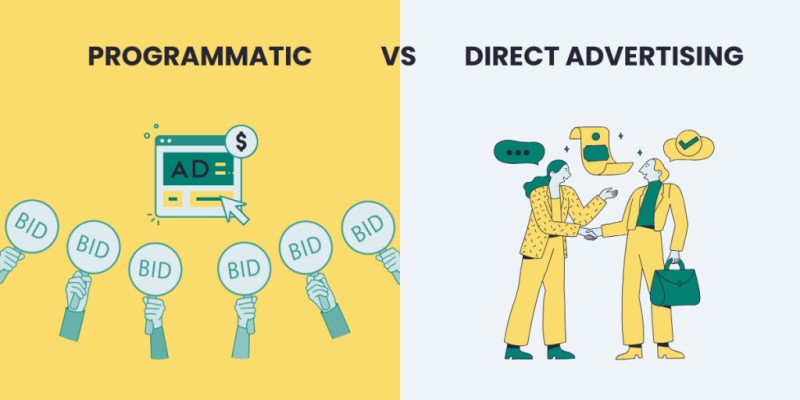
The reason display vs programmatic ads is a confusing comparison is that it is not quite an apples-to-apples distinction. Display is an ad format. Programmatic is a buying method. You can buy display ads programmatically most of the banners running on the open web today are bought this way.
When industry people say 'display ads,' they usually mean display advertising bought through a single network directly most commonly GDN through Google Ads. When they say 'programmatic,' they usually mean automated real-time buying across exchanges through a DSP, which can include display but typically also includes native, video, and other formats.
The comparison in this article follows that industry convention. 'Display ads' refers to campaigns run through closed display networks. 'Programmatic' refers to DSP-based buying across the open web. When someone says they are running 'programmatic display,' they mean display-format ads bought through a DSP a hybrid that combines the format of the first with the buying mechanism of the second.
Bud is a creative advertising agency based in Bangalore, operating since 2010 across real estate, FMCG, jewellery, B2B, education, and lifestyle categories. We are a Google Premier Partner, which means we manage Google Ads campaigns including display at a verified level of spend and performance. We also run programmatic campaigns through DSPs for clients where the audience brief justifies it.
The honest answer to which one we recommend more often: it depends entirely on the brief. A real estate developer in Bangalore with a Rs. 80,000 monthly digital budget and a well-defined property buyer persona gets a mix of Google Search and GDN retargeting managed through our Google Ads agency practice. A different client a South Indian FMCG brand pushing product trial across six tier-2 cities with Tamil and Malayalam-speaking audiences gets a programmatic setup with hyperlocal geofencing and vernacular creative, because GDN cannot deliver that combination adequately.
What we have learned running both: the decision between display and programmatic is less important than the quality of the audience thinking and creative behind it. A well-configured GDN campaign with sharp creative and disciplined exclusion management outperforms a sloppily set-up programmatic campaign every time. The tool is not the advantage. The thinking is.
Bud has won two Gold and three Silver at the Big Bang Awards 2025 and worked on 360-degree campaigns spanning TV, outdoor, social, and digital for brands across South India. Our programmatic advertising agency practice is one part of a broader capability that includes SEO, paid search, social media, content, TVC production, and brand strategy. When we recommend a display or programmatic strategy, it is in the context of what the rest of the marketing is doing not as a standalone channel decision.
These are not hypothetical. They show up repeatedly in campaigns we review when clients come to us after poor results elsewhere.
No. Programmatic is more capable but not universally better. At low budgets, in campaigns with simple objectives, or for businesses whose audience lives primarily in Google's ecosystem, display advertising through a well-managed Google Ads agency is often the more efficient choice. Better means right for the job. Programmatic is right for a different set of jobs.
Yes, and for campaigns with enough budget, running both is often sensible. GDN handles retargeting from Google Search traffic efficiently. Programmatic handles prospecting against more precisely defined audiences on the open web. They target different parts of the funnel and different inventory pools, so there is limited overlap if configured correctly.
Impressions and reach are vanity metrics unless connected to something that matters. The useful metrics depend on the campaign objective. For awareness: brand recall lift (requires a survey setup) or search volume lift for your brand name. For retargeting: assisted conversions and view-through conversions alongside direct clicks. For direct response: cost per lead or cost per acquisition benchmarked against your acceptable threshold. If a display campaign cannot show movement on any of these, the targeting, creative, or both need review.
A programmatic advertising agency operates DSP technology directly not through a reseller relationship. They build and validate audience segments using first-party and third-party data, manage bid strategies across multiple exchanges, monitor inventory quality and brand safety, and produce or specify creative across multiple formats. The meaningful differentiator is whether the agency has direct DSP access and in-house expertise to manage the campaign actively, versus passing the work to a platform that runs it automatically.
Display ads and programmatic ads are not competitors in a ranking where one beats the other. They are tools with different strengths, different requirements, and different optimal use cases. The display vs programmatic ads question is almost always the wrong question to start with. The right question is: who exactly are we trying to reach, where do they spend time online, what do we want them to do, and what budget and team are available to manage this properly?
Answer those clearly and the tool choice largely follows. A precisely defined B2B audience that reads industry publications and attends virtual conferences is a programmatic job. A consumer brand retargeting site visitors in Bangalore on a modest monthly budget is a GDN job. A national FMCG brand running a regional rollout in Tamil and Kannada markets is a programmatic job. A small retailer building their first digital campaign is a GDN job.
The mistake to avoid is reaching for the more sophisticated-sounding option because it feels like a better investment. Programmatic run badly is more expensive than display run well. And display run badly is just money spent reaching nobody in particular. The tool matters less than the thinking behind it.
The question is never display vs programmatic. It is always: who are you trying to reach, and which tool gets you there without wasting the budget you do not have to spare.
Bud India | Creative Advertising Agency, Bangalore
WE ARE AN OFFICIAL GOOGLE PREMIER PARTNER
